
The Importance of Heart Rate Control in the Treatment of Stable Angina
In many strong economies, ischemic heart disease (IHD) is the leading cause of death among people over 40 years of age [1, 2]. According to data from the Lithuanian Department of Statistics, in 2013, more than 230 thousand people died from heart and vascular diseases. It is notable that an increasing number of not only older people but also middle-aged men and women die from IHD [2].
Ischemic heart disease clinically manifests as acute syndromes, including myocardial infarction (MI) and unstable angina pectoris (UA), and chronic ischemic syndromes, including stable UA [3]. Stable UA is chest pain caused by myocardial ischemia. It is usually described as discomfort, pressure, heaviness, or a burning sensation behind the sternum, which may radiate to the left arm, neck, lower jaw, or epigastrium. It may be accompanied by shortness of breath, increased sweating, and nausea. Discomfort is usually triggered by physical or emotional stress and subsides after taking nitroglycerin.
These are typical symptoms of UA. In atypical UA, at least two of the three aforementioned symptoms are present. The diagnosis of stable UA is not confirmed by the presence of only one symptom. The severity of stable UA is assessed according to the Canadian Cardiovascular Society classification [1–3].
Recurrent chest pain in UA worsens patients' quality of life and may make them dependent on their relatives, leading to social and economic problems [3]. For patients with stable UA, it is important to ensure the best possible treatment, help them understand the disease, and establish goals for its management.
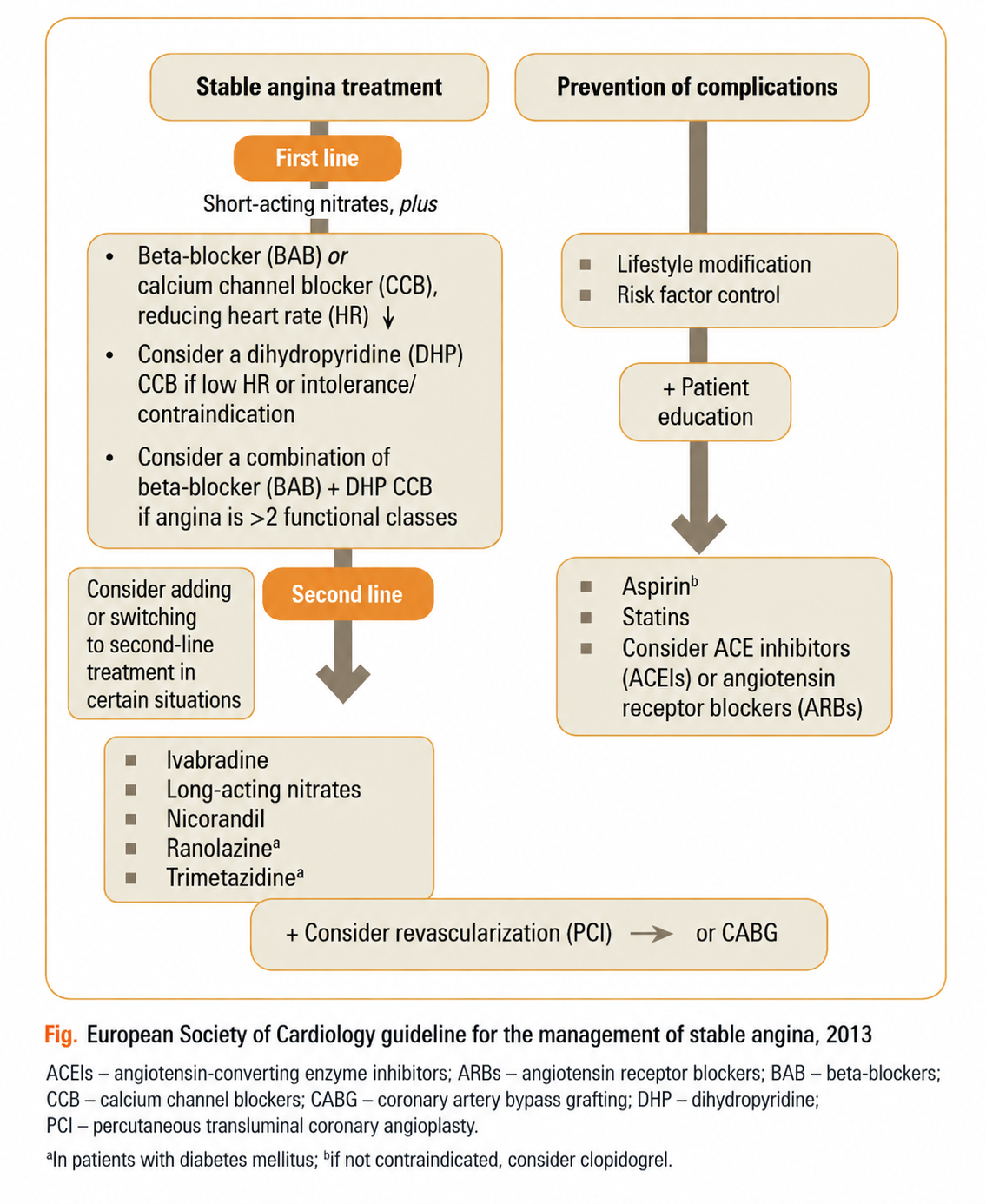
Treatment of Stable Angina and HR Control
The goals of stable UA treatment are to reduce symptoms and improve quality of life, as well as to reduce the frequency of myocardial infarction and sudden death and thereby improve survival. Treatment is recommended to begin with non-pharmacological measures and lifestyle changes. Once stable UA has been diagnosed, pharmacological therapy is usually necessary and vital [4].
All medications used to treat stable UA can be broadly divided into two groups: drugs that improve prognosis, including antiplatelet agents, lipid-lowering drugs, angiotensin-converting enzyme inhibitors (ACEIs), and beta-adrenergic receptor blockers (BABs); and drugs that reduce ischemia, including nitrates, BABs, calcium channel blockers (CCBs), K channel activators, sinus node inhibitors, and metabolism-improving drugs.
When selecting treatment, the patient's needs must be taken into account to ensure that the prescribed medications do not cause adverse effects, are easy to take, and are optimal for the patient's current condition. Heart rate (HR) control is one of the factors associated with better survival and outcomes. By reducing HR, sympathetic nervous system activity decreases and life expectancy increases [3–5].
Calcium channel blockers are among the medications that reduce ischemia and HR. CCBs block potassium entry into myocytes and smooth muscle cells, causing vasodilation. According to their chemical composition and different effects, CCBs are divided into dihydropyridines, such as amlodipine and nifedipine, and non-dihydropyridines, such as verapamil and diltiazem.
Verapamil is beneficial in the treatment of stable UA because it reduces myocardial oxygen demand by suppressing inotropic and chronotropic activity and reducing systemic blood pressure [5]. When the efficacy of nifedipine, diltiazem, and verapamil was compared in patients with stable UA, verapamil was observed to improve physical performance: in the nifedipine group, the duration of physical stress improved by 8 minutes, while in the verapamil group, it improved by 10 minutes [5, 6].
In another larger study involving 551 patients, the effects of amlodipine (10 mg/day) and its combination with atenolol (50 mg/day) were compared with long-acting verapamil administered at a dose of 480 mg/day before bedtime [5, 7]. Verapamil effectively reduced the frequency and duration of myocardial ischemia during ambulatory monitoring.
Another placebo-controlled study found that treatment of stable UA with verapamil at a dose of 360–480 mg/day improved the duration of physical stress, reduced the frequency of UA episodes, and decreased the need for nitroglycerin [5–8].
Comorbidities Accompanying Stable Angina
Another pressing issue is the global epidemic of cardiovascular diseases, obesity, and arterial hypertension, which often accompany ischemic heart disease [9–11]. When treating patients, it is important to consider not only stable UA but also comorbidities.
The international INVEST study (The International Verapamil-Trandolapril Study) compared the effects of the combination of trandolapril with verapamil and the combination of atenolol with hydrochlorothiazide in controlling arterial blood pressure [11–14]. The participants were followed for approximately 3 years. The study included 22,576 patients with arterial hypertension (AH) and advanced IHD. Of these, 52% were women, and the mean age was 66 years. One-third of all participants were over 70 years of age, with more than 2,000 over 85 years of age.
The study participants were obese and had other cardiovascular disease risk factors, including coronary disease and a history of myocardial infarction. The INVEST results revealed that the medication combinations not only controlled blood pressure but also effectively reduced the number of deaths and complications. Good results are highly likely to be achieved when treating such patients in clinical practice because, like those included in the INVEST study, they are usually elderly and have comorbidities [11].
The INVEST study successfully demonstrated for the first time that, in high-risk IHD patients, CCBs are beneficial and safe medications for treating AH and improving the condition in the presence of comorbidities such as coronary disease, previous myocardial infarction, or coronary artery bypass surgery [12].
In patients with stable angina, CCBs may be as beneficial as BBs [14]. In addition, BBs increase body weight and insulin resistance, reduce exercise tolerance, and impair sexual function, whereas CCBs do not have these adverse effects. Verapamil is a safe alternative to BBs. When verapamil was compared with atenolol, both medications were found to reduce the frequency of angina attacks equally and prolong exercise duration [5–9].
The Verapamil in Hypertension and Atherosclerosis Study, which evaluated the effect of verapamil in the treatment of AH and atherosclerosis, showed that verapamil effectively reduced blood pressure, with a decrease of approximately 16.3/16.6% in the verapamil group. LDL control was also evaluated: in the verapamil group, LDL decreased by 5.8% [13].
Table 1. Drug Treatment of Patients With Stable Angina
| Indication | Class | Level |
|---|---|---|
| General recommendations | ||
| Optimal medical treatment should include at least one anti-ischemic drug prescribed in combination with drugs for the prevention of vascular complications | I | C |
| Patients should be educated about the disease, risk factors, and treatment methods | I | C |
| It is recommended to promptly assess the patient's response to prescribed treatment | I | C |
| Treatment of angina/ischemia | ||
| Short-acting nitrates are recommended | I | B |
| For first-line treatment, beta-blockers and/or calcium channel blockers are recommended, taking into account heart rate and symptom control | I | A |
| For second-line treatment, it is recommended to add a long-acting nitrate, ivabradine, nicorandil, or ranolazine, taking into account heart rate, blood pressure, and drug tolerability | IIa | B |
| Trimetazidine may be considered as a second-line anti-ischemic treatment | IIb | B |
| Depending on comorbidities and drug tolerability, a second-line anti-ischemic drug may be prescribed instead of first-line drugs in selected patients | I | C |
| In asymptomatic patients with a large area of ischemia (>10%), treatment with beta-blockers should be considered | IIa | C |
| In vasospastic angina, treatment with calcium channel blockers and nitrates should be considered; beta-blockers should be avoided | IIa | B |
ACEIs – angiotensin-converting enzyme inhibitors.
*No prognostic benefit has been demonstrated.
Table 2. Drug Treatment of Patients With Microvascular Angina
| Recommendations | Class | Level |
|---|---|---|
| Aspirin and statins are recommended for all patients as secondary prevention therapy | I | B |
| Beta-blockers are recommended as first-line treatment | I | B |
| Calcium channel blockers are recommended if beta-blockers do not achieve adequate symptom control or if beta-blockers are not tolerated | I | B |
| ACEIs or nicorandil may be considered if symptoms persist | IIb | B |
| Xanthine derivatives or non-pharmacological treatment, such as neurostimulation procedures, may be considered in patients whose symptoms persist despite treatment with the aforementioned drugs | IIb | B |
ACEIs – angiotensin-converting enzyme inhibitors.
Safety of Drugs Used to Treat Stable Angina
No adverse hemodynamic reactions were observed with long-acting CCBs. The safety of CCBs in the treatment of AH and stable angina was evaluated in a meta-analysis of 15 clinical trials involving a total of 47,000 patients with IHD. No statistically significant differences were observed when drugs in this group were compared with ACE inhibitors, BBs, and other medications. There were also no differences in all-cause mortality compared with placebo [5].
CCBs may be used in combination with BBs if monotherapy is ineffective. The European Society of Cardiology indicates that CCBs, as first-line drugs, are suitable for reducing the symptoms of stable angina and effectively controlling LDL (Class I, Level A recommendation). A specific indication is given for the treatment of vasospastic angina, for which treatment with BBs is not recommended (Class IIa, Level B recommendation) (Table 1).
In patients with small vessel disease who experience angina, CCBs should be prescribed when BBs are not tolerated or are insufficiently effective (Class I, Level B recommendation) (Table 2).
Prepared by Dr. E. Prascienė
