
Rosacea: Etiopathogenesis, Diagnosis and Treatment Options
Introduction
Rosacea is a chronic inflammatory skin disease that most commonly affects adults (1, 2). The disease is also associated with vascular dysfunction (3). Epidemiological studies of rosacea are relatively limited. According to a study conducted in the United Kingdom, the incidence of rosacea is 1.65 cases per 1,000 people per year, with 4,000–5,000 new cases diagnosed annually (4). A German study found that 2.3% of 90,880 individuals had rosacea (5). In 80% of patients, the disease is diagnosed after the age of 30 (4, 6). In women, the risk of developing rosacea increases from the age of 35, with the highest incidence observed between 61 and 65 years of age. In men, rosacea tends to develop later, from around the age of 50, with the highest incidence observed between 76 and 80 years of age (7). Studies indicate that rosacea occurs more frequently in women, although some researchers report no significant difference between the sexes (3–5). In rare cases, the disease also occurs in children (6). Rosacea is more common in people with fair skin (skin types I–II) than in those with darker skin (8).
Rosacea primarily affects the skin of the face, although changes may also occur on the neck, chest, back, and scalp. The disease can vary in severity. Initially, transient facial erythema is characteristic, which becomes persistent over time (1, 3). Telangiectasias, most commonly affecting the cheeks, are also a characteristic symptom of rosacea (1, 3). Grade II disease is characterized by papules and papulopustules, while Grade III disease is characterized by skin thickening (1, 6). The eyes are also frequently affected, with ocular involvement observed in 20% of patients with rosacea (2).
The aim of this article is to review the etiopathogenetic aspects, clinical features, and treatment options for rosacea.
Rosacea Etiopathogenesis
The causes and pathophysiology of rosacea are not entirely clear. The development of the disease is influenced by numerous factors (1). The immune system, vascular regulation, and skin microorganisms play a significant role (1).
The innate immune system produces peptides that provide nonspecific defense against pathogens present on the skin surface. Cathelicidin is one of these peptides. The cathelicidin peptide LL-37 has antimicrobial, immunomodulatory, and blood vessel growth-promoting effects (1, 3). In individuals with rosacea, the production and activation of this peptide are disrupted (1). Patients with this condition show increased production of cathelicidin precursor molecules and proteases involved in the cleavage of this peptide. This leads to an increase in cathelicidin cleavage products in the skin, which stimulate keratinocytes to release the inflammatory cytokine interleukin (IL)-8 (1). Animal studies have shown that cathelicidin peptide fragments found in patients with rosacea exacerbate the symptoms of the disease, including erythema, edema, and skin infiltration by inflammatory cells.
It is known that Toll-like receptors (TLRs) are involved in the pathogenesis of rosacea (1, 3). These receptors are activated by specific pathogens. Increased expression of TLR2 receptors has been found in the skin of patients with rosacea. They interact with various ligands and become activated. This results in increased levels of the serine protease kallikrein 5 in keratinocytes (1, 3). Kallikrein 5 cleaves the cathelicidin peptide LL-37 into fragments with inflammatory properties (1, 3). It is believed that the ligand activating the TLR2 receptor is chitin, expressed by mites found on human skin, such as Demodex (1).
The skin of patients with rosacea shows greater colonization by Demodex folliculorum than the skin of healthy individuals (1). Treatment that reduces the number of Demodex mites also reduces the symptoms of rosacea.
The blood vessels, sensory nerves, and sebaceous glands of patients with rosacea are located very close to one another. In addition, sebaceous glands are more abundant in the skin of these individuals than in healthy individuals (1). Most patients experience episodes of facial flushing after consuming spicy food or alcohol, or in response to changes in temperature. This is explained by the direct effects of these stimuli on the sebaceous glands and by vasodilation (1, 3).
Diagnosis
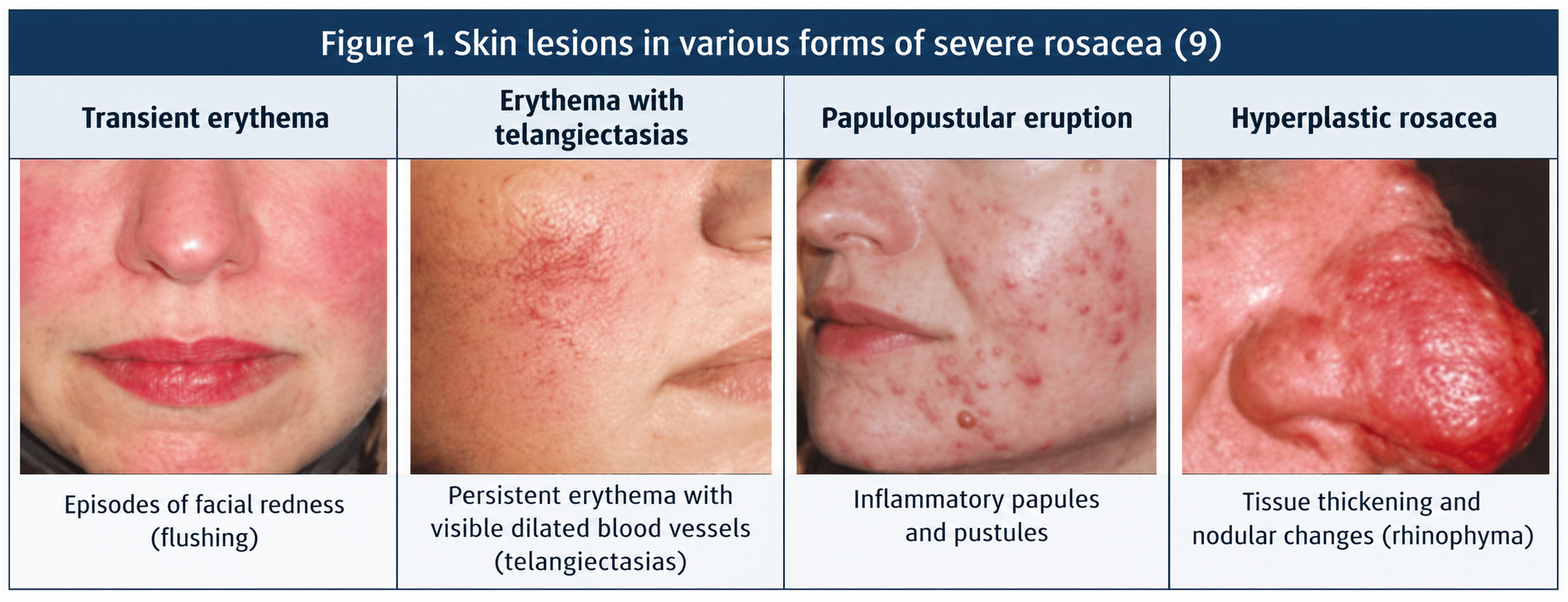
Rosacea typically presents in specific areas: the disease begins in the central part of the face, affecting the nose, forehead, and cheeks (1). In some cases, the skin of the chest, neck, and scalp may also be affected. The disease is characterized by skin redness, persistent erythema, and, in some cases, papules and pustules, lymphedema, telangiectasia, and skin thickening (Fig. 1) (3). In typical cases, erythema persists for at least 3 months and does not affect the skin around the eyes (1). Patients with rosacea may experience burning and stinging of the erythematous skin (1). Localized or diffuse edema, thickened and dry skin, and ocular involvement may also occur.
According to guidelines published by German researchers in 2013, the disease is classified according to severity (Table 1) (1). The primary form is called rosacea diathesis. It is characterized by recurrent episodes of facial flushing (1, 6). These episodes are triggered by various endogenous and exogenous factors. The most common exogenous factors include chemical irritants (cosmetics, soap), exposure to heat and cold, and ultraviolet radiation. Endogenous factors include spicy food, alcohol, hot beverages, and psychological stress (1, 6).
Table 1. Classification of Rosacea According to Severity (1)
| Disease Form | Clinical Features |
|---|---|
| Rosacea diathesis | Transient facial redness without episodes |
| Grade I rosacea (rosacea erythematosa) | Persistent erythema, telangiectasias, itching, burning, skin dryness, scaling |
| Grade II rosacea (papulopustular rosacea) | Erythema with papules and pustules, lymphedema |
| Grade III rosacea (hyperplastic rosacea) | Sebaceous gland or diffuse tissue thickening |
In rosacea of severity level I, persistent erythema and telangiectasia are present (1, 6). Most patients experience burning, stinging, itching, dryness, and flaking in the affected areas of the skin.
In rosacea of severity level II, also known as papulopustular rosacea, persistent erythema is present in the central part of the face, accompanied by scattered or grouped, symmetrically distributed red papules and pustules (1, 6). This condition can persist for weeks. Crusted papules and lymphedema, which may affect the entire face, are also characteristic of this form of the disease (1). In rare cases, the condition affects the skin of the neck, chest, and scalp. This form of the disease resembles acne but is not associated with comedones.
In rosacea of severity level III, or phymatous rosacea, hyperplasia of connective tissue and sebaceous glands occurs (1, 6). This form of the disease is characterized by nodules in the skin or diffuse thickening in the areas of the nose, forehead, cheeks, ears, and eyelids. Phymatous rosacea is more common in men (1).
The diagnosis of rosacea is based on clinical symptoms (1). In rare cases, a biopsy of the affected skin may be performed. The histological appearance of rosacea varies depending on the form of the disease. Dilated blood and lymphatic vessels, superficial perivascular and perifollicular lymphohistiocytic infiltration, moderate edema, and thickening of elastic fibers are characteristic of all forms (1).
Treatment Options
Patients with rosacea are advised to avoid factors that trigger the condition (1). Cosmetic products should be non-greasy and free of menthol or camphor, while cleansing products should not contain soap. It is recommended to avoid water-resistant cosmetics. However, decorative cosmetics do not trigger the symptoms of the disease (1). Protection against ultraviolet radiation is recommended (1).
There are no specific dietary recommendations for the treatment of rosacea, but it is advisable to avoid foods and beverages that cause vasodilation and redness, such as alcohol, spicy foods, and hot drinks. Since many different components are involved in the etiopathogenesis of rosacea, treatment is complex. For mild to moderate rosacea, topical treatment is usually sufficient. Severe cases may require a combination of topical and systemic treatment. Topical treatments often include metronidazole, azelaic acid, permethrin, and clindamycin. The mechanism of action of metronidazole is unclear, but it has anti-inflammatory and immunosuppressive properties that help reduce the symptoms of rosacea. Azelaic acid has anti-inflammatory properties and is involved in the regulation of keratinization. Creams that strengthen capillary walls and reduce their dilation are also used.
Systemic treatment is prescribed for severe, treatment-resistant rosacea. Commonly prescribed medications include tetracyclines, macrolide antibiotics, metronidazole, and isotretinoin. Alternative treatment methods described in the scientific literature include photodynamic therapy and laser treatment.
Summary
Rosacea is a common chronic skin condition characterized by facial redness that is initially episodic and later becomes persistent. More severe forms of the disease are characterized by telangiectasia, papulopustular rash, lymphedema, and skin thickening. Common triggers include cosmetics, alcohol, hot foods, and psychological stress. Rosacea most commonly affects people over 30 years of age.
The etiopathogenesis of this condition is complex and involves various factors, including increased TLR2 receptor expression, the number of Demodex mites, and impaired vascular regulation. It is believed that Demodex mites activate TLR2 receptors, which promote an increase in the serine protease kallikrein 5. Kallikrein 5 cleaves the cathelicidin peptide LL-37 into inflammatory fragments that stimulate keratinocytes to produce IL-8, leading to ongoing inflammatory processes in the skin. Additionally, due to increased numbers of mast cells and impaired vascular regulation, various stimuli cause vasodilation. These factors contribute to the clinical manifestations of rosacea.
Various medications are used to treat rosacea, but none can completely cure the condition. The first recommendation is to avoid triggering factors, followed by topical or systemic treatment with antibiotics or azelaic acid, depending on the severity of the disease.
Laura Tamašauskienė
Source: "Internistas"
