
OMEGA-3 FATTY ACIDS: Does Bioavailability Depend on the Pharmacological Form?
The beneficial effects of omega-3 fatty acids on health have long been recognized [1], and interest in them has increased significantly over the past decade. This has been influenced by recent research findings presented by scientists, media coverage, and patient experiences shared by word of mouth. There has been extensive discussion, research, and accumulation of information regarding the quality and bioavailability of fish oils and the different molecular forms of fish oil offered by various pharmaceutical companies. Recently, considerable attention has been drawn to krill oil (krill are small, shrimp-like crustaceans from the Antarctic Ocean – Author’s note), which has been claimed to have greater bioavailability, suggesting that fish oil may be less effective. Because scientific opinions have differed, a comparative study was conducted, the results of which did not confirm the superiority of krill oil [2].
Omega-3 Fatty Acids
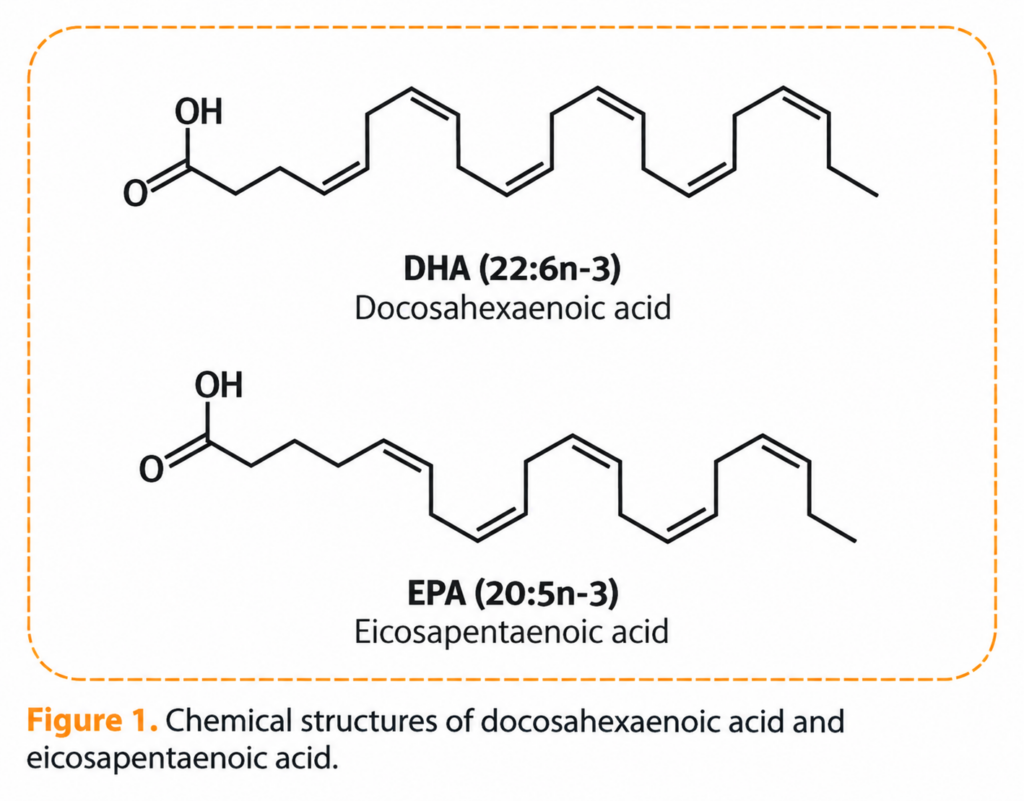
Omega-3 fatty acids are polyunsaturated fatty acids that the body cannot produce on its own. The principal omega-3 fatty acids include eicosapentaenoic acid (EPA), docosahexaenoic acid (DHA) (Figure), and alpha-linolenic acid (ALA). The first two, which are among the most important, are obtained mainly from marine fish such as tuna, salmon, herring, mackerel, and sardines, with smaller amounts found in trout, halibut, cod, and perch. Alpha-linolenic acid is obtained from plant-based foods such as flaxseed, hemp, rapeseed, walnuts, wheat germ and soybean oil, green leafy vegetables, and nuts.
Long-chain n-3 polyunsaturated fatty acids (omega-3 fatty acids) act in two ways: directly, for example by replacing arachidonic acid as an eicosanoid substrate and inhibiting arachidonic acid metabolism, and indirectly, for example by altering the expression of inflammatory genes through effects on transcription factor activity [3]. Thus, omega-3 fatty acids are potentially potent agents in preventing inflammation.
However, the benefits of omega-3 fatty acids are not limited to their anti-inflammatory and immunomodulatory effects. Their effects on the cardiovascular system are among the most extensively studied. It has been demonstrated that an adequate intake of omega-3 fatty acids reduces the risk of cardiovascular disease (CVD) complications [4, 5]. Most studies indicate that DHA is also important for memory, cognition, metabolic processes, and brain function [6, 7, 8].
EPA and DHA, which belong to the omega-3 fatty acid group:
- improve autonomic nervous system function;
- inhibit platelet aggregation;
- have vasodilatory properties;
- reduce arrhythmias and arterial blood pressure and inhibit the development of atherosclerosis;
- improve endothelial function;
- stabilize blood clots;
- reduce concentrations of free fatty acids and triglycerides;
- regulate adiponectin synthesis;
- reduce the formation of collagen deposits [9].
According to data from three clinical trials conducted in 2008 involving 32,000 patients, the likelihood of CVD complications decreased by 19–45% among those who increased their intake of omega-3 fatty acids or used fish oil supplements. Based on these studies, an increased intake of both EPA and DHA is recommended, particularly for individuals with CVD risk factors. In patients with these diseases, omega-3 fatty acid intake should be approximately 1 g/day, compared with 500 mg/day in those without CVD. In patients with hypertriglyceridemia, 3–4 g/day of EPA/DHA reduces triglyceride levels by 20–50%. Combined treatment with omega-3 fatty acids and statins is a safer and more effective approach for reducing blood lipid levels and improving CVD prognosis than statin therapy alone [9].
The randomized clinical DART (Diet and Reinfarction Trial) included 2,033 patients who had experienced myocardial infarction. They were advised to modify three dietary factors: reduce total fat intake, increase the ratio of polyunsaturated to saturated fatty acids, and consume more fish and cereal products. Mortality among patients who increased their fish consumption decreased by 29% over 2 years [8].
The strength of the effects of different types of omega-3 fatty acids on the body varies. After entering the body, alpha-linolenic acid is converted through a series of enzyme-mediated reactions into EPA and DHA, from which biologically active substances are produced. When EPA and DHA enter the body directly, the body does not need to carry out these reactions or utilize the corresponding enzymes. Therefore, these fatty acids can be used more quickly and easily for the synthesis of biologically active substances. For this reason, they are more effective [10].
Three forms of fatty acids are currently available on the pharmaceutical market: ethyl esters, triglycerides, and phospholipids. An ethyl ester is formed when one fatty acid is bound to one ethanol molecule. Ethyl esters belong to a lipid class that is highly regarded in the British Pharmacopoeia [11]. Ethyl esters do not occur naturally and are produced by chemical synthesis.
The triglyceride form consists of three fatty acids, such as EPA and DHA, attached to a glycerol backbone. This is the molecular form that constitutes nearly all animal and plant fats and oils. Omega-3 fats found in fish are almost exclusively present in triglyceride form [12].
The recommended daily intake of long-chain n-3 polyunsaturated fatty acids for adults has not been established. However, the U.S. Academy of Nutrition and Dietetics, the largest organization of nutrition experts in the United States, recommends at least 500 mg/day [2].
According to the Panel on Dietetic Products, Nutrition and Allergies, achieving the beneficial effects of omega-3 fatty acids on blood pressure and blood triglyceride concentrations requires a daily intake of 2–4 g of EPA and DHA, while 250 mg/day is sufficient for the preventive improvement of cardiac function; this amount is considered safe for both children and adults [13].
Because few people obtain sufficient omega-3 fatty acids from food, supplements containing these fatty acids may be necessary. Are they safe for daily use? According to the European Food Safety Authority, daily supplemental intake of up to 5 g of omega-3 fatty acids does not increase the risk of reported adverse events. The expert panel noted that varying dietary intakes of omega-3 fatty acids had not demonstrated adverse effects in either healthy adults or children. After reviewing the available data, it concluded that supplemental EPA and DHA, in combination, at doses of up to 5 g/day are safe to consume [13].
Does the Bioavailability of Omega-3 Fatty Acids Depend on the Different Molecular Forms of Fish and Krill Oils?
Conflicting information has recently emerged regarding differences in the bioavailability of various forms of omega-3 fatty acids. Several studies have suggested that the phospholipid form is absorbed more effectively than ethyl ester or triglyceride forms. However, these studies did not use equivalent DHA and EPA concentrations, which may have contributed to questionable conclusions.
A study was therefore conducted [2] to evaluate the bioavailability of orally administered omega-3 fatty acids using identical doses of EPA and DHA in different forms: fish oil ethyl esters, fish oil triglycerides, and the phospholipid form found in krill oil.
The study was double-blind, randomized, multidose, and parallel-group in design. It included 66 healthy adults aged 18–60 years. Among the exclusion criteria, participants could not have used any dietary supplements during the 3 months before the study and could not have consumed fish more than twice per week during the 14 days before the start of the study.
Participants were divided into three groups of 22 subjects each and received either krill oil, fish oil in triglyceride form, or fish oil ethyl esters. The EPA/DHA dose was the same in all three groups: approximately 816 mg of EPA and 522 mg of DHA per day, irrespective of the form.
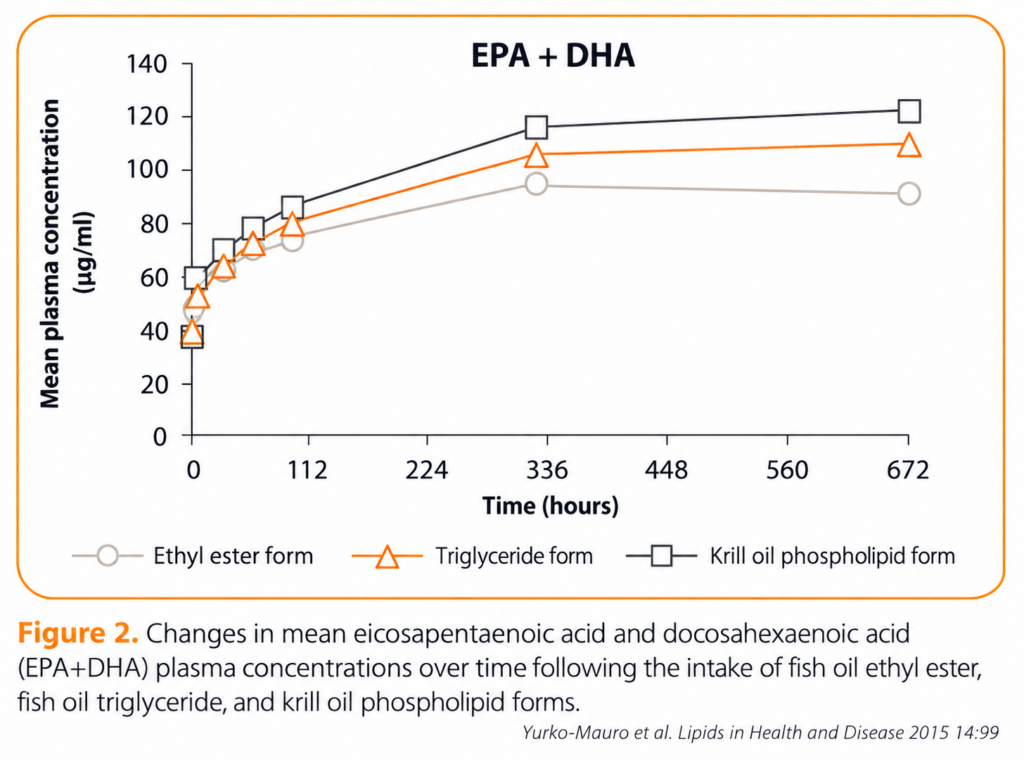
Participants took six capsules per day for a total of 28 days. The primary endpoint was the measurement of plasma EPA+DHA concentrations after 4 weeks of supplementation. At the baseline visit, omega-3 fatty acid concentrations were measured in plasma and red blood cells. To assess the dynamics of changes in EPA/DHA concentrations, measurements were repeated after 4, 8, 12, 48, and 72 hours, after 14 days (336 hours), and finally after 4 weeks (672 hours).
The 4-week duration was selected deliberately, as this is the period during which plasma omega-3 fatty acid concentrations are expected to reach a plateau. After 4 weeks, no significant difference in plasma EPA/DHA concentrations was observed among the three study groups: the mean concentration was 90.9 ± 41 µg/ml in the fish oil ethyl ester group, 108 ± 40 µg/ml in the fish oil triglyceride group, and 118.5 ± 48 µg/ml in the krill oil phospholipid group (p=0.052). EPA/DHA concentrations also did not differ significantly among the groups when fatty acid concentrations were measured in erythrocytes (p=0.19).
No significant differences in EPA/DHA concentrations in red blood cells were observed among the three groups. Bioavailability in all three groups was almost identical 48 hours after administration. The study found no differences in omega-3 fatty acid bioavailability according to molecular form—phospholipids, triglycerides, or ethyl esters (Figure 2) [2].
The researchers suggested that unequal doses, different EPA/DHA concentrations, short study durations, and poor adherence may have contributed to the less comprehensively supported conclusions of earlier studies suggesting that the omega-3 phospholipid form found in krill oil is more effective than the triglyceride form found in fish oils and plant-derived oils. Moreover, another study [15], published in April of the same year, demonstrated that phospholipids are not responsible for greater bioavailability: over 72 hours, krill meal was not absorbed more effectively than fish oil.
Summary
Omega-3 fatty acids, including docosahexaenoic acid and eicosapentaenoic acid, provide broad benefits for the heart, brain, and overall health. This has been confirmed in clinical studies [16–19]. However, consumption of oily fish, the main source of omega-3 fatty acids, is insufficient in Western countries. Therefore, to obtain an adequate daily intake of omega-3 fatty acids, supplementation, for example with fish oil, may be necessary.
Studies have not confirmed the superiority of any particular molecular form of fish or krill oil in terms of fatty acid bioavailability. These findings challenge previously conflicting views and indicate that the dose of omega-3 fatty acids, rather than their form of administration, is important for achieving long-term health benefits. Therefore, when selecting a product, it is important to consider its omega-3 fatty acid content and choose products from established manufacturers with extensive experience, as this can help ensure quality and safety.
Prepared by Dr. S. Žukauskas
