
Effectiveness of Rosehip Powder Preparations in Patients With Knee Osteoarthritis
Introduction
Osteoarthritis (OA) is a common joint disease that can develop in any joint with a synovial lining and most commonly affects the joints of the hands, knees, hips, and spine (1). Patients with knee OA are most often troubled by pain; therefore, reducing pain is essential for maintaining functional activity (2). Various approaches are used to relieve OA symptoms, including pharmacological and surgical treatment and lifestyle modifications (2–5). Dietary supplements and alternative therapies are also frequently used to alleviate OA symptoms. These include over-the-counter preparations in powder, tablet, or other forms that are not considered food products (6), and their use should be evidence-based (7).
At the beginning of December this year, Professor Robin Christensen from the Department of Rheumatology at the Parker Institute, Copenhagen University Hospital, attended the Move Healthy conference in Kaunas, where he presented a report on the benefits of nonsteroidal anti-inflammatory drugs, intra-articular preparations, and dietary supplements for relieving knee joint pain, including the use of rosehip powder preparations.
One promising preparation used to reduce OA symptoms is powder made from the rosehips of wild rose (Rosa canina) (8). Rosehips are commonly used in cases of infectious and inflammatory diseases (9), and randomized trials suggest that rosehip powder made from the fruit and seeds may relieve pain caused by OA (8). According to in vitro studies, R. canina powder has anti-inflammatory activity by inhibiting the chemotaxis of peripheral blood neutrophils and monocytes in healthy individuals. In addition, patients with OA who use rosehip powder have been found to have reduced C-reactive protein concentrations (10, 11) and pain (12).
A previous meta-analysis demonstrated a clinically significant pain-relieving effect of R. canina powder (8). It included studies using powder made from R. canina fruit and seeds, and the effective dose was determined to be 6 capsules per day. Taking such a large number of capsules can be challenging for patients and may affect adherence to the treatment regimen (13). One way to increase potency is to concentrate the active substances. In vitro comparison of the anti-inflammatory effects of powders containing active substances from the seeds with powders that did not contain seeds showed that the latter were more effective, suggesting that the rosehip fruit—its pulp or peel—contains more active substances than the seeds (14).
This article presents data from the REPORT study, which compared the effectiveness of rosehip powder containing seeds with 2 other seedless preparations in patients with OA.
Rosehip Powder Preparations
Rosehips are harvested when fully ripe. The newer rosehip preparations do not contain seeds; fresh rosehip peels are dried and ground into a fine powder. In contrast, older rosehip preparations contain seeds. During their production, harvested rosehips are frozen, thawed before drying, and ground into a fine powder, which is then supplied as a dietary supplement in capsule or powder form. Seeds, whose main component is oil rich in polyunsaturated fatty acids, account for 40–60% of the dry weight of rosehips (17, 18).
Removing the seeds from the newer preparation concentrates the substances with anti-inflammatory properties found in rosehip peels: flavonoids, carotenes, triterpene acids, and galactolipids. The preparation is standardized by supplementing it with vitamin C to provide 80 mg of the recommended daily nutritional value.
Study Design
The study was conducted over 12 weeks at the Department of Rheumatology at Frederiksberg Hospital in Denmark. This randomized trial investigated the effects of 3 different rosehip preparations in patients with OA (30). Participants were older than 40 years, had clinically confirmed OA diagnosed according to the American College of Rheumatology criteria (15), had radiographic signs of OA (16), and rated their knee joint pain at no less than 40 mm on a 100-mm Visual Analogue Scale (VAS). Patients with morbid obesity (BMI >40 kg/m²), concomitant arthritis of another origin, those already using rosehip preparations, those who were not fluent in Danish, and those with mental disorders that could affect adherence to the treatment regimen were excluded from the study.
Patients were treated for 12 weeks with 3 different rosehip powder preparations in identical-looking capsules:
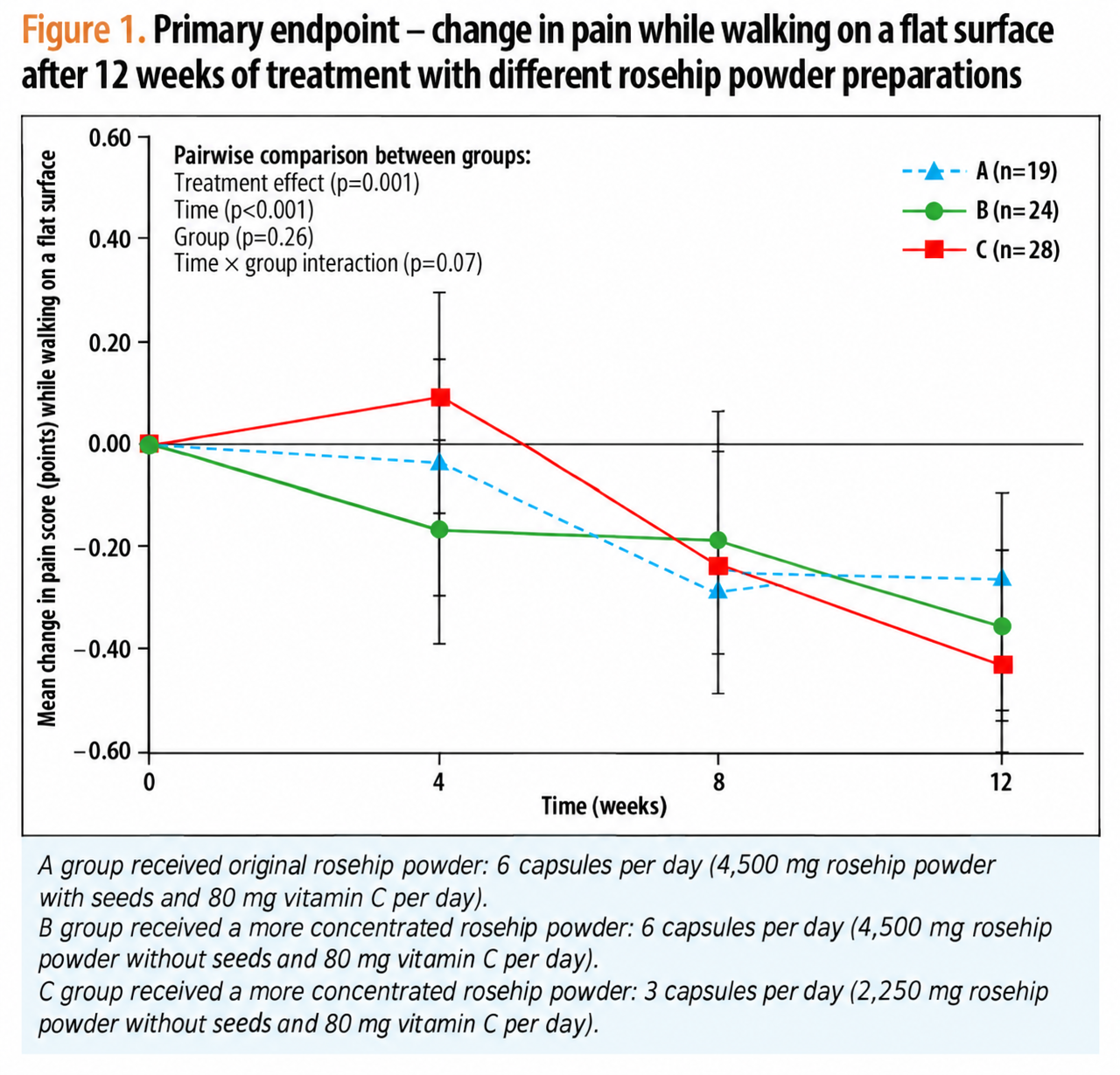
● The first group (group A) received the original rosehip powder, 6 capsules per day (4,500 mg of rosehip powder with seeds and 80 mg of vitamin C per day).
● The second group (group B) received a more concentrated rosehip powder, 6 capsules per day (4,500 mg of seedless rosehip powder and 80 mg of vitamin C per day).
● The third group (group C) received a more concentrated rosehip powder, 3 capsules per day (2,250 mg of seedless rosehip powder and 80 mg of vitamin C per day).
The primary endpoint was the reduction in pain while walking on a flat surface, assessed as the change from baseline after 12 weeks of treatment. Pain was rated on a Likert scale from 0 to 4 using the pain-while-walking-on-a-flat-surface subscale of the KOOS (Knee Injury and Osteoarthritis Outcome Score) (19, 20).
The secondary endpoints were scores on the 5 other KOOS subscales (19, 20), the patient’s global assessment of disease using a 100-mm VAS, and quality of life assessed using the SF-36 questionnaire (Medical Outcomes Study 36-item Short-Form General Health Survey) (21, 22). The KOOS assessment is completed by the patient and evaluates pain, symptoms, activities of daily living, ability to participate in sports and maintain functional activity, and knee-related quality of life (19, 20, 23). Adherence to the treatment regimen was assessed by counting the number of rosehip powder capsules taken.
Table 1. Primary and Secondary Endpoint Values After 12 Weeks of Treatment
| Variable | Group A (n=49)† | Group B (n=49)† | Group C (n=51)† | B Group vs. A Group, Difference (95% CI) | C Group vs. A Group, Difference (95% CI) |
|---|---|---|---|---|---|
| KOOS scale variables | |||||
| Change in pain while walking on a flat surface (SD) | −0.3 (0.1) | −0.3 (0.1) | −0.4 (0.1) | −0.06 (−0.35–0.22) | −0.14 (−0.42–0.15) |
| Change in activities of daily living (SD) | 5.4 (1.8) | 7.4 (1.8) | 6.6 (1.8) | 1.97 (−3.16–7.09) | 1.15 (−3.95–6.26) |
| Change in knee OA-related quality of life (SD) | 7.8 (1.7) | 7.8 (1.7) | 9.3 (1.7) | 0.00 (−4.73–4.73) | 1.49 (−3.21–6.20) |
| Change in overall pain (SD) | 6.1 (2.0) | 10.2 (1.9) | 7.4 (1.9) | 4.06 (−1.40–9.53) | 1.29 (−4.16–6.73) |
| Change in ability to participate in sports (SD) | 9.4 (2.4) | 8.7 (2.2) | 8.4 (2.2) | −0.76 (−6.89–5.37) | −1.06 (−7.16–5.05) |
| Change in symptoms (SD) | 2.1 (1.8) | 6.4 (1.8) | 8.0 (1.8) | 4.33 (−0.75–9.40) | 5.97 (0.92–11.02) |
| SF-36 questionnaire variables | |||||
| Change in mental component summary score (SD) | −1.44 (0.97) | 1.89 (0.96) | −0.65 (0.95) | 3.33 (0.62–6.04) | 0.80 (−1.91–3.49) |
| Change in physical component summary score (SD) | 1.60 (0.95) | 2.86 (0.94) | 2.34 (0.93) | 1.26 (−1.37–3.89) | 0.74 (−1.91–3.38) |
| OMERACT-OARSI response | |||||
| Change in pain according to VAS (SD) | −9.4 (3.0) | −10.7 (3.0) | −16.6 (2.9) | −1.30 (−9.62–7.02) | −7.22 (−15.50–1.05) |
| Change in functional status according to VAS (SD) | −4.3 (2.9) | −5.7 (2.8) | −9.0 (2.8) | −1.42 (−9.37–6.53) | −4.67 (−12.58–3.24) |
| Change in patient global assessment according to VAS (SD) | −1.8 (2.9) | −1.3 (2.9) | −8.2 (2.9) | 0.45 (−7.76–8.66) | −6.43 (−14.61–1.75) |
| OMERACT-OARSI response, n (%) | 26 (53) | 23 (46) | 28 (55) | −7 (−27–13) | 2 (−18–21) |
† Group A received the original rosehip powder, 6 capsules per day; Group B received the more concentrated rosehip powder, 6 capsules per day; Group C received the more concentrated rosehip powder, 3 capsules per day.
‡ Statistically significant difference between the more concentrated rosehip powder (3 capsules per day) and the original preparation (p=0.0199).
§ Statistically significant difference between the more concentrated rosehip powder (6 capsules per day) and the original preparation (p=0.0264).
VAS – Visual Analogue Scale; SD – standard deviation.
Another secondary endpoint of the study was treatment effectiveness according to the OMERACT-OARSI (Outcome Measures in Rheumatology–Osteoarthritis Research Society International) criteria (24). These criteria define substantial improvement as a reduction in pain or improvement in function of ≥50%, with an absolute change of ≥20%; or improvement in at least 2 of 3 measures: pain reduction of ≥20% or an absolute change of ≥10%, functional improvement of ≥20% or an absolute change of ≥10%, and improvement in the patient’s global assessment of ≥20% or an absolute change of ≥10% (25). Adverse events were recorded during the study (26, 27).
Results
The study included 150 patients (49 in group A, 50 in group B, and 51 in group C). Most participants were women (73%), the mean age was 64.7 years, and the mean BMI was 29.2 kg/m². There were no significant differences between the groups. The 12-week treatment period was completed by 45, 47, and 47 patients, respectively. There was no significant difference between the groups in the number of patients who discontinued treatment (p=0.93). Adherence to the treatment regimen, assessed by counting the capsules taken at each visit every 4 weeks, ranged from 18% to 115% (some patients took more capsules than prescribed). No difference in adherence was observed between the groups, with rates of 99.6%, 97.0%, and 98.8%, respectively (p=0.13).
Table 2. Adverse Events Reported During the 12-Week Period
| Adverse Event | Group A, n (%)† | Group B, n (%)† | Group C, n (%)† | p-value |
|---|---|---|---|---|
| Gastrointestinal symptoms | ||||
| Nausea | 6 (12) | 15 (30) | 11 (22) | 0.098 |
| Indigestion | 10 (20) | 11 (22) | 14 (27) | 0.695 |
| Constipation | 8 (16) | 11 (22) | 13 (25) | 0.542 |
| Abdominal bloating | 18 (37) | 14 (28) | 19 (37) | 0.558 |
| Abdominal pain | 14 (29) | 14 (28) | 20 (39) | 0.426 |
| Vomiting | – | 2 (4) | 5 (10) | 0.510 |
| Abdominal cramps | 12 (24) | 12 (24) | 19 (37) | 0.270 |
| Heartburn | – | 8 (16) | 8 (16) | 1.000 |
| Biliary symptoms | 1 (2) | 2 (4) | 4 (8) | 0.504 |
| Musculoskeletal symptoms | ||||
| Myalgia | 13 (27) | 7 (14) | 12 (24) | 0.282 |
| Joint pain | 9 (18) | 9 (18) | 12 (24) | 0.788 |
| Back pain | 12 (24) | 15 (30) | 21 (41) | 0.200 |
| Joint swelling | 14 (29) | 12 (24) | 10 (20) | 0.584 |
| Sciatic nerve pain | 11 (22) | 5 (10) | 14 (27) | 0.070 |
| Central nervous system and psychological symptoms | ||||
| Dizziness | 13 (27) | 11 (22) | 13 (25) | 0.890 |
| Headache | 11 (22) | 17 (34) | 13 (25) | 0.427 |
| Insomnia | 5 (10) | 4 (8) | 5 (10) | 0.941 |
| Sleepiness | 8 (16) | 14 (28) | 15 (29) | 0.258 |
| Fatigue | 9 (18) | 9 (18) | 17 (33) | 0.137 |
| Mood changes | 10 (20) | 9 (18) | 11 (22) | 0.935 |
| Cognitive impairment | 11 (22) | 6 (12) | 6 (12) | 0.272 |
| Skin and subcutaneous tissue symptoms | ||||
| Dry skin | 14 (29) | 7 (14) | 11 (22) | 0.216 |
| Allergic rash | 6 (12) | 8 (16) | 5 (10) | 0.648 |
| Skin redness | 9 (18) | 8 (16) | 4 (8) | 0.259 |
| Eczema | 2 (4) | 4 (8) | 6 (12) | 0.395 |
| Perianal itching | 10 (20) | 13 (26) | 11 (22) | 0.782 |
| Skin irritation | 6 (12) | 7 (14) | 8 (16) | 0.956 |
| Urticaria | – | 3 (6) | – | 0.069 |
| Other symptoms | ||||
| Feeling hot | 13 (27) | 11 (22) | 9 (18) | 0.565 |
| Sweating | 10 (20) | 10 (20) | 7 (14) | 0.624 |
| Heart palpitations | 3 (6) | 3 (6) | 4 (8) | 1.000 |
| Shortness of breath | 3 (6) | 8 (16) | 10 (20) | 0.129 |
| Toothache | 11 (22) | 5 (10) | 6 (12) | 0.183 |
† Group A received the original rosehip powder, 6 capsules per day; Group B received the more concentrated rosehip powder, 6 capsules per day; Group C received the more concentrated rosehip powder, 3 capsules per day.
During the 12 weeks of treatment, pain while walking on a flat surface did not decrease significantly (p=0.95); however, a possible statistical interaction between treatment and time was observed (treatment × time: p=0.075), suggesting that the response to the different rosehip powder preparations may differ over time. During treatment, the difference in pain while walking on a flat surface between groups B and A was –0.06 points (95% CI –0.35 to 0.22; p=0.66), while the difference between groups C and A was –0.14 points (95% CI –0.42 to 0.15; p=0.34).
When pain was assessed using the KOOS scale, no differences were found between the groups. Comparing the more concentrated rosehip powder (group B, 6 capsules per day) with the original rosehip powder (group A, 6 capsules per day), the difference was 4.06 points (95% CI –1.40 to 9.53; p=0.14). Comparing the more concentrated rosehip powder (group C, 3 capsules per day) with the original rosehip powder (group A, 6 capsules per day), the difference was 1.29 points (95% CI –4.16 to 6.73; p=0.64).
Overall, all rosehip powder preparations were equally effective with regard to the secondary endpoints. However, with the more concentrated rosehip powder taken as 3 capsules per day, OA symptoms assessed using the KOOS symptoms subscale decreased more than with the original rosehip powder taken as 6 capsules per day (difference 5.97 points; 95% CI 0.92–11.02; p=0.01990). In addition, quality of life, assessed by the mental component of the SF-36 questionnaire, improved more with the more concentrated rosehip powder taken as 6 capsules per day than with the original powder (difference 3.33 points; 95% CI 0.64–6.04; p=0.0164).
Overall, the incidence of adverse events was similar across all study groups. Some adverse events were more frequently recorded in the more concentrated rosehip powder groups, although no statistically significant differences were found between the groups. This suggests potentially different effects of these preparations. Among gastrointestinal adverse events, nausea was the most common, occurring in 6 patients (12%) in the original rosehip powder group, 15 patients (30%) in the more concentrated rosehip powder group taking 6 capsules per day, and 11 patients (22%) in the more concentrated rosehip powder group taking 3 capsules per day (p=0.098). Among musculoskeletal adverse events, sciatic nerve pain was the most common and occurred somewhat more frequently in the more concentrated rosehip powder group taking 3 capsules per day. A trend toward a higher incidence of urticarial rash (p=0.069) was observed in the more concentrated rosehip powder group taking 6 capsules per day.
To determine whether the effectiveness of treatment with the more concentrated rosehip powder taken as 3 capsules per day differed in a clinically meaningful way from treatment with the original rosehip powder taken as 6 capsules per day, a hypothesis based on specific criteria was developed (39–41). Tubach and colleagues reported minimal clinically important improvement (MCII) values for 4 generic outcomes in the treatment of 4 rheumatic diseases (41). A post hoc analysis of the study data assessed how many patients achieved the absolute (15–100 units) and relative (20%) MCII values.
Pain decreased by at least 15 KOOS units in 31% of patients in the original rosehip powder group, 30% in the more concentrated rosehip powder group taking 6 capsules per day, and 33% in the more concentrated rosehip powder group taking 3 capsules per day (p=0.93). The relative MCII value, defined as an improvement of at least 20% from baseline, was achieved by 39%, 40%, and 33% of patients, respectively (p=0.76). The post hoc analysis showed that the preparations were equally effective.
Discussion
The results of the REPORT study are consistent with other data in the literature showing that different rosehip powder preparations reduce pain while walking on a flat surface in patients with knee OA. In this study, no statistically significant differences were observed between the original formulation and the more concentrated preparations with regard to the primary endpoint and most secondary endpoints. However, the more concentrated rosehip powder preparation taken as 3 capsules per day reduced knee OA symptoms assessed using the KOOS scale more effectively than the original preparation taken as 6 capsules per day.
The REPORT study data support the use of the newer, more concentrated rosehip powder preparations made exclusively from rosehip peels without seeds as a preferable approach to reducing knee OA symptoms compared with the original preparations. With the newer preparations, the number of capsules can be reduced to 3 per day. The analgesic effect of the newer rosehip powders is provided by potentially active substances including flavonoids, carotenes, triterpene acids, galactolipids, and vitamin C.
The American College of Rheumatology recently published guidelines for the pharmacological and non-pharmacological treatment of OA (42). Traditionally, initial treatment of knee OA includes paracetamol, oral and topical nonsteroidal anti-inflammatory drugs, tramadol, intra-articular corticosteroid or hyaluronic acid injections, duloxetine, and other opioid analgesics (42). However, the use of these drug classes is often limited by inconsistent effectiveness and various adverse events (2). Dietary supplements made from food-derived raw materials, meanwhile, may provide additional health benefits without causing significant adverse events. For example, as many as 90% of patients with arthritis in the United States use alternative medicine approaches (43). Powder made from the fruit of wild rose (R. canina) has a consistent mild-to-moderate analgesic effect in knee OA, while adverse events occur at a frequency similar to that observed with placebo. These preparations are therefore considered safe to use (8). The only adverse event associated with the more concentrated rosehip powder that occurred more frequently and appeared to be dose-related was nausea.
REPORT was not designed to establish superiority or equivalence between different preparations; rather, it was a dose-finding study. Nevertheless, focusing on the group of patients taking 3 capsules per day, a post hoc analysis demonstrated that the preparation provided a minimal clinically important improvement (44).
Summary
The newer, more concentrated rosehip powder preparations made from rosehip peels are as effective as the older original preparations that also contain seeds. The newer, more concentrated rosehip powder preparations can be taken at a lower dosage of 3 capsules per day. As with all dietary supplements, rosehip powder preparations should be further investigated in phase III clinical trials.
Prepared by Dr. Liucija Vaitkevičiūtė
Source: Internistas, No. 10
