
Soft Tissue Injuries: The PRICE Method
Introduction
During the cold season, injuries are a particularly relevant issue. Winter is the time of year when few of us manage to avoid slipping, twisting an ankle, or falling. In fortunate cases, the consequences are limited to sprains, bruises, dislocations, or other minor injuries. Pain may persist for some time, the function of the affected area may be impaired, and bruising often provides visible evidence of the injury. However, winter alone should not be blamed for injuries. Various injuries occur throughout the year in many everyday situations, including sports, entertainment, and active leisure. The cold season simply creates additional opportunities for injury every time we leave home.
Whenever an injury occurs, soft tissues are affected to some degree because they anatomically connect, support, and surround all organs and other structures of the body. The extent of the damage depends on the severity of the injury and the individual characteristics of the person. In cases of soft tissue injury, the PRICE (Protection, Rest, Ice, Compression, Elevation) method is used: the injured area is protected, rested, cooled with ice, compressed, and elevated. However, these measures are not always sufficient. Nonsteroidal anti-inflammatory drugs (NSAIDs), preparations that promote the resorption of bruises, electrotherapy, manual therapy, bandaging, and rehabilitation may significantly improve treatment effectiveness.
Soft Tissue Injury
Soft tissue injury is one of the major causes of pain and disability, with considerable social and economic consequences due to lost working days. Quality of life is also affected by the psychological impact of disruption to normal daily activities. Soft tissue injury is an acute injury to connective tissue, including muscles, ligaments, tendons, and capsules. These tissues may be damaged during ordinary everyday activities, although injuries have been observed to occur more frequently during sports or recreational activities (1).
Soft tissue injuries are classified into three grades according to severity (2). A first-degree injury (mild injury) is usually caused by mild stretching of ligaments or capsular structures. Clinically, minimal swelling and moderate bruising may be observed, together with mild pain that is usually felt at the end of the range of motion or during muscle stretching and contraction. Joint instability or functional impairment is not observed, although minimal muscle spasms may occur.
A second-degree injury (moderate injury) results from moderate or excessive stretching of ligaments or capsular structures or from a direct impact on the muscles, resulting in rupture of a certain number of muscle fibers. Clinically, moderate swelling and often bruising are observed. Moderate pain occurs with every movement that interferes with the muscle’s ability to contract or lengthen. Second-degree ligament or capsular injuries may also cause some degree of joint instability. Moderate muscle spasms may occur in response to injury to ligaments, capsules, or muscles. Ruptured fibers reduce the tensile strength of ligaments and capsular structures and decrease the contractile strength of some muscles. All of these changes contribute to functional impairment.
A third-degree soft tissue injury (severe injury) occurs when ligaments or muscles are overstretched or when muscles are subjected to a direct impact. This results in complete rupture of the affected structure. Clinically, pronounced swelling and bruising are observed, and severe pain is usually present, even at rest. Ligament injury causes joint instability and markedly reduces tensile strength. Muscle injuries cause severe muscle spasms, stiffness, and restriction until the affected muscle is unable to contract. The function of the affected tissue or structure is severely impaired.
In acute soft tissue injury, during the first 72 hours, treatment according to the PRICE method is recommended. Pain- and inflammation-relieving medications, preparations promoting the resorption of bruises, and other treatment methods may also be used (Table 1).
Table 1. Alternative Treatment Methods That May Be Used Together With the PRICE Method During the First 72 Hours After the Onset of Soft Tissue Injury (2)
| First-Degree Injury (Mild Injury) | Second-Degree Injury (Moderate Injury) | Third-Degree Injury (Severe Injury) |
|---|---|---|
| NSAIDs (oral, topical) | NSAIDs (oral, topical) | NSAIDs (oral, topical) |
| Electrotherapy (interferential current therapy, TENS, ultrasound therapy, pulsed electromagnetic field, laser therapy) | Electrotherapy (interferential current therapy, TENS, ultrasound therapy, pulsed electromagnetic field, laser therapy) | Electrotherapy is generally not used due to the need for further research |
| Manual therapy (e.g., joint mobilization, stretching, proprioceptive neuromuscular facilitation) | Manual therapy is generally not applied to the injured area during the first 72 hours | Manual therapy should not be applied due to the need for further research |
| Taping (protection during activity) | Taping (protection of the injured area at rest) | Taping/splinting (to protect the injured area at rest and during activity) |
| Rehabilitation (may be prescribed immediately after the injury, ensuring protection of the injured area) | Rehabilitation is generally not applied during the first 72 hours. Light activity outside the injured area may be prescribed | Rehabilitation is not applied due to the need for further research |
NSAIDs – nonsteroidal anti-inflammatory drugs; TENS (Transcutaneous Electrical Nerve Stimulation) – transcutaneous electrical nerve stimulation.
PRICE Method
PRICE is one of the simplest and oldest methods for treating soft tissue injuries, such as sprains, bruises, and dislocations (3). Following soft tissue injury, the body responds with an acute inflammatory reaction. Clinically, this manifests as increased temperature of the affected area, redness, pain, and swelling and, depending on the location of the injury, functional limitation. Following a soft tissue injury, ruptured blood vessels lead to hematoma formation, capillary permeability increases, swelling develops, plasma proteins and leukocytes migrate, and inflammation develops at the site of injury. This inflammatory phase lasts 24–72 hours (4–5). It is therefore not surprising that many authors recommend following the PRICE protocol during the first hours, up to 72 hours after injury (6):
- P (protection) – protect the injured ankle from repeated injury.
- R (rest) – stop any activity that causes pain.
- I (ice) – cool the injured ankle for 15–20 minutes, 4–8 times per day.
- C (compression) – compression of the injured ankle helps reduce swelling; an elastic bandage may be used.
- E (elevation) – keep the injured limb elevated as much as possible to reduce swelling.
In cases of acute soft tissue injury, the affected area should first be protected against possible repeated injury and rested. During the acute phase, intensive movement should be avoided and exercise should not be performed. Researchers using animal models recommend a short period of protection/rest; according to more recent reviews, 2–5 days of immobilization, because prolonged immobilization results in undesirable changes in tissue biomechanics and morphology within 2–3 weeks (3).
Although it may seem paradoxical, gradually increasing mechanical loading is more likely to restore the strength and morphological characteristics of collagen tissue after injury. Although this has not been fully investigated, available data suggest that mechanical loading increases the expression of genes encoding key proteins involved in soft tissue healing (3). Thus, immobilization should gradually be replaced by increasingly active movement, and stretching of healing tissues is beneficial during rehabilitation. Such treatment is often referred to as functional treatment.
The basis of cold therapy is to cool the injured area in order to reduce pain and locally slow cellular metabolism. The degree of cooling required and how this should be achieved clinically remain matters of debate. Nevertheless, most evidence indicates that cold-induced analgesia is achieved when the temperature of the cooled skin falls below 13 °C, while slowing of metabolism is observed at skin temperatures of 5–15 °C (3). In each individual case, the circumstances of the injury and clinical rationale should be taken into account. An analgesic effect is likely to be achieved after 5–15 minutes of cooling with crushed ice (3). Other cooling methods require longer cooling periods to achieve the optimal skin temperature for analgesia. It should be noted that skin temperature does not indicate the temperature of deeper tissue layers, which is very difficult to reduce to the desired level.
In a healthy body, a dynamic fluid balance is maintained between the vascular system and the interstitium. This depends largely on the interaction between hydrostatic and osmotic pressures at the capillary level. Acute soft tissue injury followed by an inflammatory response can affect both hydrostatic and osmotic pressures and disturb their balance. Around the injured area, hydrostatic pressure increases because of changes in blood viscosity and flow within the vessels; macromolecules accumulate in the intercellular space and alter the osmotic gradient. Consequently, fluid movement through the blood vessels increases, more fluid accumulates in the intercellular space, and edema develops.
Thus, one of the main reasons for applying compression and elevation to an injured part of the body is edema. External mechanical compression or gravity through elevation can help restore pressure gradients within the injured tissue (3). The optimal angle and duration of elevation are also matters of debate. Elevating the injured body part reduces both pain and perceived discomfort. It would appear logical that, to limit tissue edema and prevent the pain and discomfort associated with increased tissue pressure, the limb should be elevated as high as possible and kept elevated for as long as possible. However, excessively prolonged elevation may result in a so-called rebound effect, in which fluids rapidly return to their original position when the person sits or stands. Therefore, return to an upright position should be gradual. It is suggested that more distal body parts should be kept elevated for longer periods than proximal body parts.
Compression of injured tissues may reduce initial tissue bleeding after injury. This method is ineffective in cases of muscle injury. Compression also helps prevent edema by making it more difficult for fluid to accumulate in the intercellular space. Only a low level of pressure is required to achieve this effect. Many standard protocols recommend maintaining a pressure of 15–35 mm Hg (3).
Dolmen®, Fastum® Gel, Lioton 1000® – Effective Treatment for Soft Tissue Injuries
Early treatment of a soft tissue injury can be effective only when applied appropriately. Otherwise, treatment may cause more harm than benefit. For example, chronic edema may worsen the outcomes of subsequent treatment, complicate rehabilitation, and increase the risk of reinjury (1). Soft tissue injuries generally require a comprehensive treatment approach aimed at relieving pain, reducing swelling, and promoting hematoma resorption. The PRICE method alone is not always sufficient to achieve these goals.
Dexketoprofen trometamol is an effective and safe NSAID for pain relief. Dexketoprofen is the water-soluble salt of the R-enantiomer of ketoprofen, which inhibits the cyclooxygenase (COX) enzyme 3,000 times more strongly than the S-enantiomer (NSAIDs reduce pain and inflammation by acting on COX isoforms). The trometamol salt improves the physicochemical properties of dexketoprofen and provides a rapid and potent analgesic effect (7). Dexketoprofen trometamol is readily soluble in water and is well absorbed through the gastrointestinal mucosa. The drug is indicated for the relief of mild to moderate musculoskeletal pain, dysmenorrhea, and dental pain and has analgesic, anti-inflammatory, and antipyretic effects (1). The maximum concentration of dexketoprofen trometamol in the human body is reached after 30 minutes (range 15–60 minutes), while its analgesic effect lasts for 4–6 hours. The distribution half-life and elimination half-life of dexketoprofen trometamol are 0.35 and 1.65 hours, respectively. Multiple-dose pharmacokinetic studies have shown that the area under the concentration-time curve after the last dose is the same as after a single dose. This indicates that the drug does not accumulate in the body (8).
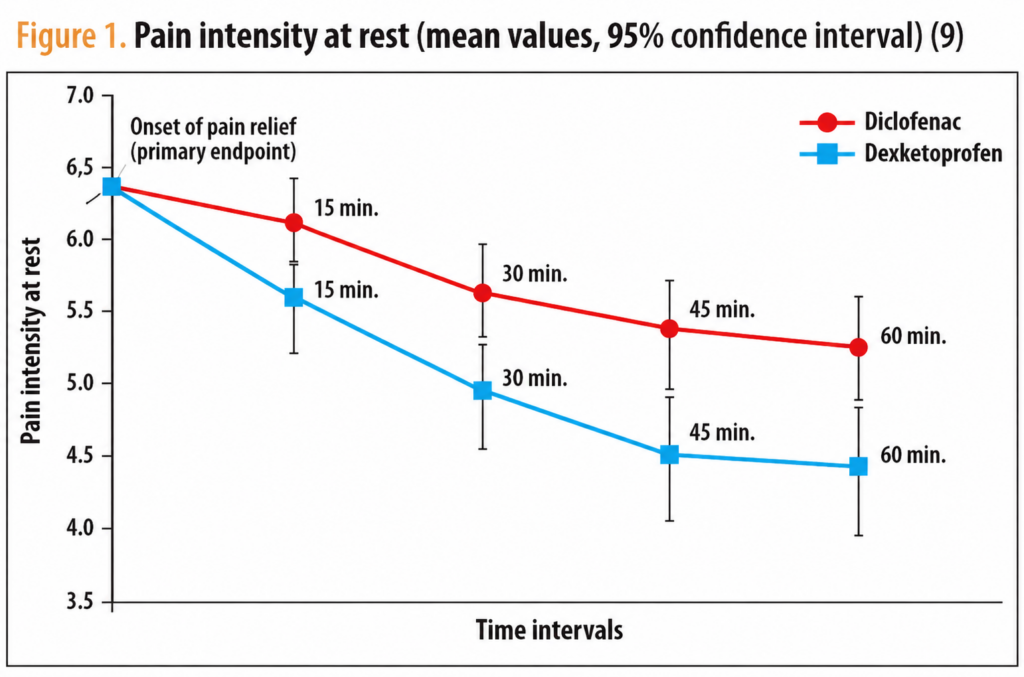
To evaluate differences in the onset and effectiveness of analgesia between two widely used NSAIDs, dexketoprofen and diclofenac, in patients with pain caused by soft tissue injury, a clinical study was conducted (9). This was a prospective, double-blind, randomized controlled trial involving patients with acute lower-limb injuries. Patients who met the study inclusion/exclusion criteria received either 25 mg oral dexketoprofen trometamol or 50 mg diclofenac sodium after the injury. Pain scores were assessed at baseline and every 15 minutes during the first hour. A total of 122 patients were included in the study (65 patients in the dexketoprofen group and 75 in the diclofenac group). There were no significant differences between the two groups in age, sex, type of injury, or baseline pain score. The differences in pain scores between patients receiving diclofenac and dexketoprofen at 15, 30, 45, and 60 minutes after injury were 0.53 (95% confidence interval 0.03–1.09), 0.70 (0.16–1.24), 0.89 (0.32–1.47), and 0.83 (0.21–1.45), respectively (9). The odds ratios for reducing pain by at least 1 point from baseline on an 11-point scale when dexketoprofen was administered instead of diclofenac at 15, 30, 45, and 60 minutes were 2.66 (1.19–5.98), 3.52 (1.60–7.73), 4.48 (1.72–11.65), and 5.54 (1.90–16.15), respectively. The corresponding odds ratios for reducing pain by ≥2 points were 6.88 (1.48–32.0), 3.79 (1.59–9.01), 5.19 (2.29–11.78), and 5.87 (2.68–12.88) (9). Analysis of the study data led to the conclusion that dexketoprofen trometamol is an effective and rapidly acting analgesic for the treatment of acute musculoskeletal injuries (Figure 1) (9).
Among topical NSAIDs, Fastum® Gel is a well-established treatment used for local pain and inflammation associated with soft tissue contusions, chronic inflammatory joint diseases, and acute ligament and muscle strains. One gram of gel contains 25 mg of ketoprofen, one of the most effective topical NSAIDs. A thin layer of gel is applied to the affected area 1–3 times daily. Ketoprofen, appropriately combined with excipients, reaches the site of inflammation transcutaneously through the skin and can therefore be used to treat sprains and contusions involving joints, tendons, ligaments, and muscles (10). Fastum® Gel is particularly valued for the local action of its analgesic component.
An open-label, randomized, multicenter study was conducted to compare commonly prescribed gels for soft tissue injuries (11). The study compared 2.5% ketoprofen gel, 0.5% piroxicam gel, and 1% diclofenac gel, administered three times daily for 5 days within 48 hours of the soft tissue injury. Treatment efficacy, tolerability, and acceptability were evaluated. The study included 1,575 patients. Of these, 1,048 used ketoprofen gel (in 525 patients, the gel was dispensed using a special device), 263 used piroxicam gel, and 264 used diclofenac gel. Ketoprofen gel was superior to piroxicam gel in terms of overall response to treatment (improvement in 74% vs. 65%), reduction in muscle stiffness (71% vs. 64%), reduction in movement restriction (34% vs. 22%), and reduction in tenderness on pressure (81% vs. 78%). Ketoprofen and diclofenac gels were compared in a similar manner. Greater improvement was observed in the ketoprofen group (38%) than in the diclofenac group (30%). According to the study, patient acceptability of ketoprofen gel was considerably greater than that of piroxicam gel. Many participants described the cooling effect of ketoprofen gel (71%) as stronger than that of piroxicam gel (49%) or diclofenac gel (60%). Ketoprofen gel was very well tolerated. Based on the available study data, ketoprofen gel is effective in the treatment of acute soft tissue injuries (11).
Soft tissue injuries often require not only analgesic treatment but also therapy aimed at improving microcirculation. An ointment containing heparin, such as Lioton 1000®, is effective in reducing swelling and bruising. According to the official indications provided in the Summary of Product Characteristics, Lioton 1000® is indicated for the treatment of injuries and contusions, localized infiltrates and swelling, subcutaneous bruising, and post-traumatic injuries of muscles, tendons, joint capsules, and ligaments (12). One gram of Lioton 1000® gel contains 1,000 IU of heparin sodium. The gel is applied to the skin over the affected area and gently rubbed in 1–3 times daily. Experimental pharmacological data indicate that Lioton 1000® has a strong effect on swelling, granuloma formation, and fluid exudation into tissues, has anti-inflammatory properties, and reduces coagulation (12).
A prospective, randomized, double-blind clinical trial involving three treatment groups—a diclofenac epolamine (DHEP) 180 mg/heparin 5,600 IU patch, a DHEP patch, and placebo—was conducted, with time to complete hematoma resorption as the primary endpoint (13). The study included 185 patients (90 men and 95 women aged 18–80 years). Baseline clinical and demographic characteristics were similar across all treatment groups. Time to complete hematoma resorption was shorter in the DHEP/heparin patch group than in both the DHEP patch and placebo groups (p<0.05). Thus, heparin was the principal factor responsible for this effect. Patients using the DHEP/heparin patch had a 60% probability of achieving complete hematoma resorption within 10 days of treatment compared with patients using the DHEP patch alone or placebo (13).
Summary
Soft tissue injuries affect almost everyone at some point, although the severity of the injury and resulting complications vary. Such injuries are often accompanied by swelling, bruising, functional limitation, and pain. These clinical manifestations not only impair quality of life, create a socioeconomic burden, and have negative psychological effects, but, if not properly treated, may also adversely affect subsequent stages of treatment and complicate rehabilitation after injury. The PRICE method is recommended within 72 hours of a soft tissue injury. Because this approach alone does not always achieve the desired treatment goals, alternative treatment methods may also be required. Pharmacological treatment is generally aimed at relieving pain both systemically (e.g., Dolmen®) and topically (e.g., Fastum® Gel), reducing swelling, and promoting the resorption of bruising (e.g., Lioton 1000®). Timely and effective treatment during the acute phase of an injury is essential for successful rehabilitation and complete recovery.
Source: Internistas, No. 1, 2016.
