
How to Diagnose and Treat Chronic Spontaneous Urticaria
Chronic spontaneous urticaria is defined as a condition characterized by the spontaneous appearance of wheals and/or angioedema that recur for six weeks or longer due to known or unknown causes [1, 2]. Urticaria symptoms result from mast cell degranulation, during which numerous mediators are released, including histamine, platelet-activating factor, tryptase, leukotrienes, prostaglandins, and others. These mediators activate sensory nerves, promote vasodilation, increase plasma extravasation, and contribute to the accumulation of inflammatory cells in the skin [1, 2].
Urticaria can be triggered by various factors, including medications and chemical substances (particularly nonsteroidal anti-inflammatory drugs (NSAIDs), salicylates, and food additives), certain foods (nuts, fish, and seafood), contact substances, cosmetics, physical factors (pressure, heat, cold, and water), inhaled allergens, infections, systemic diseases, endocrine disorders, and other factors that remain poorly understood [1–3].
Chronic spontaneous urticaria is often unrelated to environmental factors and is frequently associated with autoimmune mechanisms. This association is supported by the detection of autoantibodies in 30–50% of cases [4, 5]. Chronic spontaneous urticaria is the most common form of chronic urticaria, accounting for approximately two-thirds of all cases [6].
In 2015, a retrospective study was presented that analyzed data collected between 2010 and 2013 from the five largest European Union (EU) countries: France, Germany, Italy, Spain, and the United Kingdom. The study examined the prevalence of chronic urticaria and its impact on patients' quality of life, healthcare utilization, work productivity, daily activities, and psychological well-being [7].
These parameters were compared between patients receiving treatment for chronic urticaria and individuals without the condition. A total of 175,923 respondents were included in the study. The prevalence of chronic urticaria was found to be 0.5% [7], while 0.2% of respondents were receiving treatment for the condition [7].
Depression, anxiety, sleep disturbances, reduced daily activity and work productivity, poorer quality of life, and healthcare visits were more common among patients receiving treatment for chronic urticaria than among individuals without the disease [7].
The findings of this representative study demonstrated that chronic urticaria is a common condition that substantially affects patients' daily lives. Therefore, timely diagnosis and effective treatment are particularly important. Treatment should aim to minimize symptoms while remaining well tolerated and safe for patients.
How Is Chronic Spontaneous Urticaria Diagnosed?
All forms of urticaria share characteristic clinical manifestations, including wheals and/or angioedema [1, 2] (Figure 1).
A wheal is a skin lesion characterized by swelling of varying size in the central area, surrounded by erythema. It is accompanied by itching and typically resolves within 1–24 hours [1, 2].
Angioedema is characterized by swelling of the deeper layers of the skin and subcutaneous tissue, which resolves within 72 hours. The mucous membranes may also be affected [1, 2].
Urticaria is diagnosed based on clinical manifestations and classified according to disease duration and underlying causes [1, 2]. Diagnosis, identification of potential causes, and treatment are carried out by an allergist or dermatologist.
Patients frequently attend specialist consultations without visible clinical manifestations because urticarial wheals are transient and migratory.
Therefore, a detailed medical history is particularly important, including an accurate description of the rash, its onset, duration, and possible association with environmental or other factors. In cases of acute urticaria (symptoms recurring for less than six weeks), diagnostic testing is generally not recommended unless an allergy is suspected [1–3]. Acute urticaria is most commonly associated with infections or antibiotic use. Consequently, symptoms usually resolve after recovery from the infection and discontinuation of treatment and may never recur [1, 2].
In patients with chronic urticaria, routine and extended diagnostic investigations are performed to identify the underlying cause [1, 2]. Chronic urticaria is classified into spontaneous and inducible forms. Chronic inducible urticaria is triggered by environmental factors. Therefore, when this form is suspected, provocation tests involving physical stimuli are performed according to the suspected trigger [1, 2].
Diagnosing chronic spontaneous urticaria, the most common form of chronic urticaria, is particularly challenging. In many cases, the underlying cause remains unidentified. When evaluating patients with chronic spontaneous urticaria, it is essential to obtain a detailed medical and personal history, paying particular attention to comorbidities, possible chronic sources of infection, and medications being taken [1–3].
A complete blood count and inflammatory markers, including erythrocyte sedimentation rate (ESR) and C-reactive protein (CRP), are also recommended [1, 2]. If symptoms recur, further investigations are performed according to the suspected cause. These may include autoantibody testing and evaluation for infections (such as Helicobacter pylori), type I hypersensitivity, thyroid disorders, malignancies, and other potential underlying conditions [1, 2].
How Is Chronic Spontaneous Urticaria Treated?
Once the underlying causes of chronic spontaneous urticaria have been identified, treatment begins by addressing or eliminating these factors [1, 2]. If medications are suspected of triggering the condition, discontinuation and replacement with drugs from another therapeutic class are recommended. Any identified infection should be treated [1, 2].
If urticaria is caused by an IgE-mediated food allergy, the responsible food must be eliminated from the diet [1, 2]. Patients frequently associate urticaria symptoms with certain foods, even when no specific sensitization can be demonstrated. In such cases, food additives or naturally occurring substances in certain products may trigger pseudoallergic reactions. Avoidance of these foods is therefore recommended [1, 2].
If the underlying cause cannot be identified or symptoms persist despite its elimination, pharmacological treatment is initiated. The pathogenesis of urticaria involves mast cell degranulation and the release of biologically active substances responsible for its clinical manifestations. Histamine is one of the most important mediators, making H1 receptor antagonists the first-line treatment [1, 2].
Second-generation antihistamines are recommended because they provide prolonged effects, have relatively few adverse reactions, and cause little or no central nervous system sedation.
Glucocorticoids also reduce inflammatory cell infiltration into tissues. However, they should be prescribed only in short courses for severe urticaria that is resistant to conventional treatment or during severe exacerbations [1, 2]. If high levels of autoantibodies are detected and pharmacological treatment is ineffective, plasmapheresis may be recommended to remove these antibodies.
According to the guidelines applicable at the time, pharmacological treatment follows a three-step approach [1, 2]. The first step involves initial treatment with H1 receptor antagonists at standard doses. If symptoms persist after two weeks of antihistamine treatment, the dose should be gradually increased up to fourfold (step II) [1, 2].
If symptoms remain uncontrolled after one to four weeks of step II treatment, a medication from step III should be added. These include the leukotriene receptor antagonist montelukast, the immunosuppressant cyclosporine, which moderately inhibits mediator release from mast cells and basophils, and the anti-IgE agent omalizumab [1, 2].
Omalizumab for the Treatment of Chronic Spontaneous Urticaria
Omalizumab is a monoclonal antibody that selectively binds to the C3 domain of the IgE heavy chain, preventing IgE from binding to receptors on the surface of mast cells and basophils [8]. Over time, the number of these receptors on the cells gradually decreases [9].
Omalizumab is included in step III of urticaria treatment and is indicated for patients aged 12 years and older with chronic spontaneous urticaria whose symptoms are inadequately controlled by antihistamines [1].
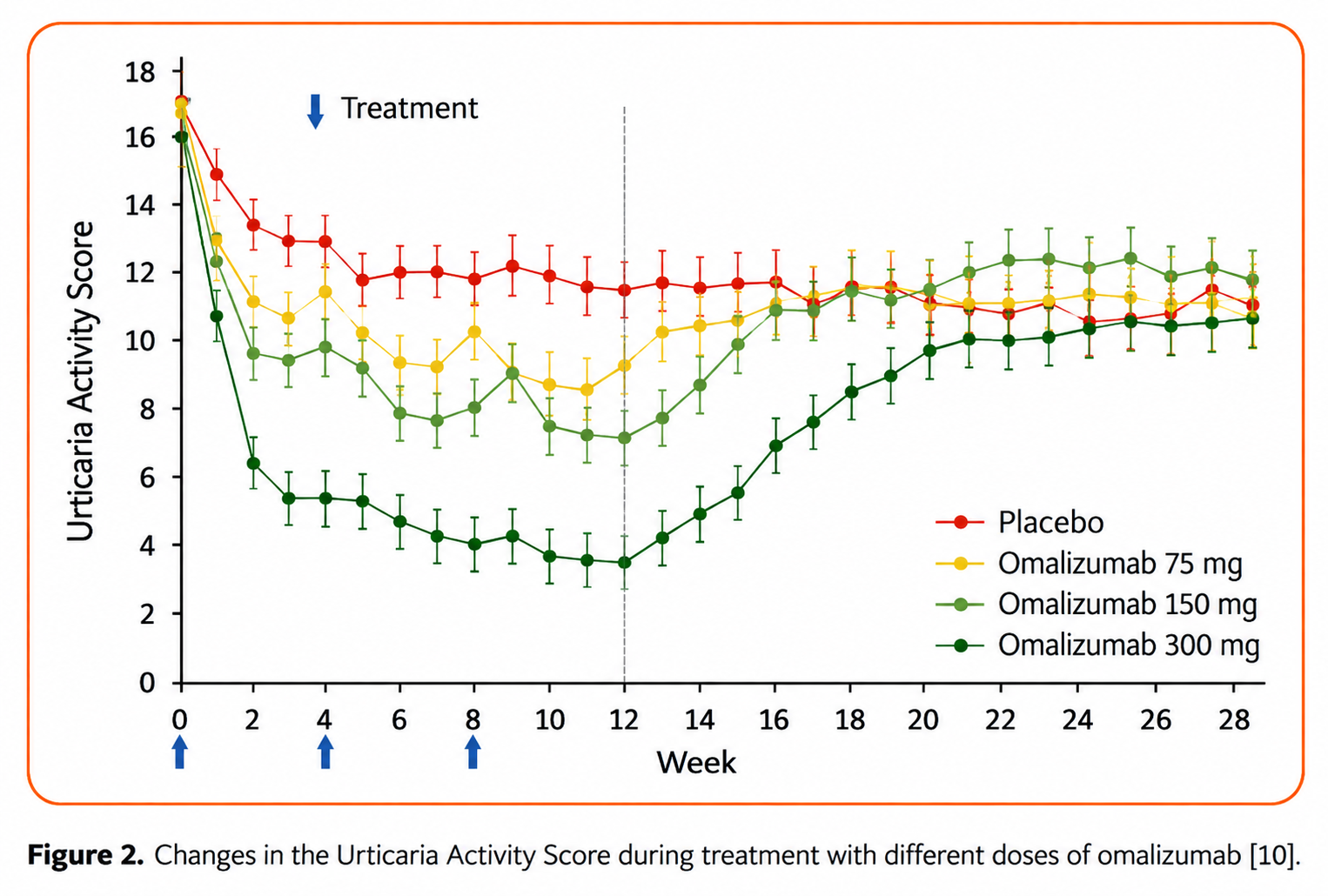
A phase III placebo-controlled clinical trial demonstrated the efficacy and safety of omalizumab in treating moderate to severe chronic spontaneous urticaria that was resistant to antihistamines [10]. The study included 323 patients aged 12 years and older. Participants received subcutaneous injections of omalizumab at doses of 75 mg, 150 mg, or 300 mg, or placebo, every four weeks for 12 weeks. Before treatment, the patient-reported itch severity score was approximately 14.
The results showed that, at week 12, the mean change from baseline in the itch severity score was −8.1 ± 6.4 (p = 0.001) in the 150 mg omalizumab group and −9.8 ± 6.0 (p < 0.001) in the 300 mg group. In contrast, the mean change in the 75 mg omalizumab group was −5.9 ± 6.5 (p = 0.46), compared with −5.1 ± 5.6 in the placebo group [10].
The wheal score decreased significantly in all omalizumab-treated groups compared with placebo, with the greatest reduction observed among patients receiving the 300 mg dose (Figure 2) [10]. From week 12 onward, during the observation period when treatment was no longer administered, wheal scores began to increase in the omalizumab groups, approaching those observed in the placebo group. However, they did not return to baseline values throughout the follow-up period (Figure 1) [10].
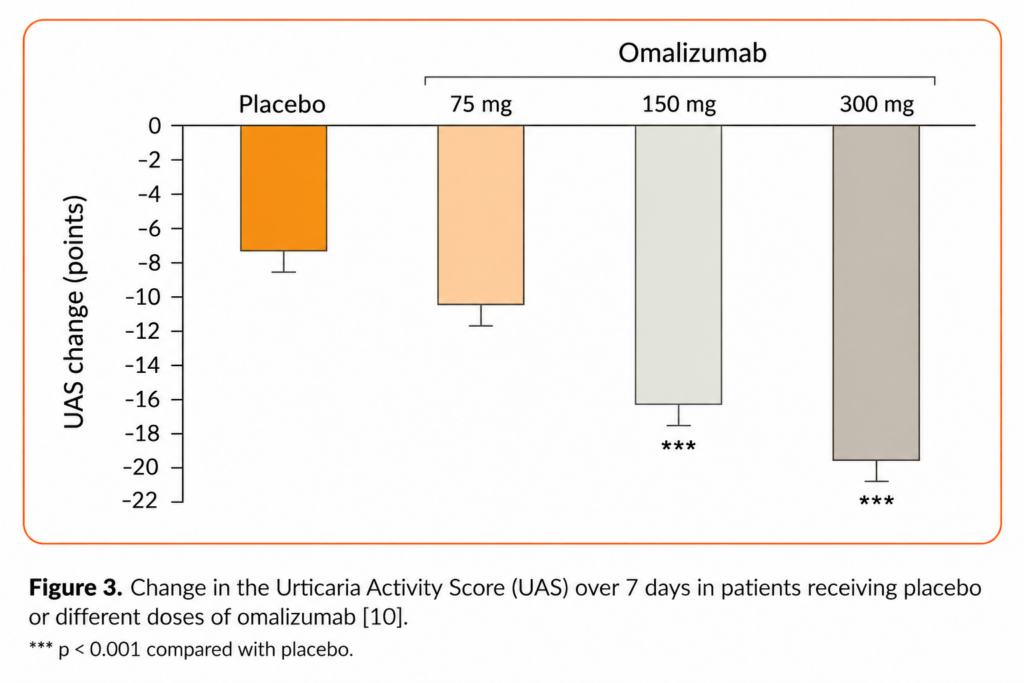
At week 12, wheals had completely disappeared in 10% of patients receiving placebo, 18% of those receiving 75 mg omalizumab, 23% receiving 150 mg, and 53% receiving 300 mg. Complete resolution of both itching and wheals, defined as a Urticaria Activity Score over seven days (UAS7) of 0, was achieved in 5%, 16%, 22%, and 44% of patients in the placebo, 75 mg, 150 mg, and 300 mg omalizumab groups, respectively [10].
When disease activity was assessed using UAS7, the greatest reduction was observed among patients receiving 300 mg omalizumab (Figure 3) [10].
The overall number of adverse events was low, although it was higher in the 300 mg group than in the other treatment groups [10].
In 2016, a meta-analysis of clinical trials was published evaluating the efficacy and safety of different omalizumab doses in the treatment of chronic spontaneous urticaria [11]. The analysis included seven placebo-controlled clinical trials involving 1,312 patients with chronic spontaneous urticaria.
Patients treated with different doses of omalizumab, ranging from 75 mg to 600 mg administered every four weeks, experienced significant reductions in itching and wheal scores compared with those receiving placebo [11].
The magnitude of the treatment effect was dose-dependent, with the greatest reductions in itching and wheal scores observed in patients treated with 300 mg omalizumab [11]. Complete resolution of clinical symptoms was significantly more common among patients receiving omalizumab than among those receiving placebo. The highest rate of complete symptom resolution was observed in patients treated with the 300 mg dose [11].
Omalizumab was well tolerated, and the incidence of adverse events did not differ between patients receiving omalizumab and those in the control group [11].
Summary
Chronic spontaneous urticaria is the most common form of chronic urticaria. Although the condition is diagnosed based on clinical manifestations, identifying its underlying causes is extremely difficult and often impossible.
Chronic spontaneous urticaria has a substantial negative impact on patients' daily activities, quality of life, and psychological well-being. Treatment is based on established clinical guidelines.
When the underlying cause is known, treatment focuses on eliminating it. If the condition does not improve, stepwise pharmacological treatment is initiated. First-line medications are antihistamines, whose doses may be increased up to fourfold if clinical symptoms persist.
If symptoms continue despite treatment with the maximum recommended doses of histamine receptor antagonists, an additional medication from step III is introduced.
Currently, the most extensive evidence regarding the effectiveness of treatment for chronic spontaneous urticaria is available for omalizumab. Clinical trials have demonstrated that this medication effectively reduces itching and wheal scores, with the best outcomes achieved using a 300 mg dose administered every four weeks.
Omalizumab is generally well tolerated. Meta-analyses have shown no significant difference in adverse event rates between omalizumab and placebo, while adverse reactions associated with omalizumab were classified as mild or moderate in severity.
