
Persistent Cough: Causes, Diagnosis and Treatment
Introduction
Cough is a reflex response of the body to stimulation of sensory nerves. During coughing, intrathoracic pressure increases and air is expelled at high velocity, thereby removing dust, dead cells, and unnecessary secretions from the respiratory tract. Therefore, cough is one of the respiratory tract's defense mechanisms. However, cough receptors are located not only in the epithelium of the upper and lower respiratory tract but also in the pericardium, esophagus, diaphragm, and stomach. Cough may also be caused by chemical or mechanical irritation of these receptors. Cough is one of the most common symptoms prompting patients to seek medical attention from family physicians and pulmonologists (1).
According to duration, cough can be classified as acute (lasting less than 3 weeks), subacute (lasting 3–8 weeks), or chronic (lasting >8 weeks) (2). Acute cough is most commonly caused by respiratory tract infections and less frequently by exacerbations of chronic lung diseases, pneumonia, or pulmonary embolism. Subacute cough is often post-infectious and resolves spontaneously without specific therapy (3).
Three main causes of chronic cough are identified in 92–100% of non-smoking patients with no abnormalities on chest X-rays. These are upper airway cough syndrome (previously known as postnasal drip syndrome), asthma, and gastroesophageal reflux disease (GERD) (4). Prolonged cough may also be caused by medications such as angiotensin-converting enzyme inhibitors (ACE inhibitors). Less common causes of cough include respiratory tract diseases and disorders, such as chronic bronchitis, bronchiectasis, tumors, and foreign bodies, as well as lung parenchymal disorders, including interstitial lung diseases and abscesses.
The worldwide prevalence of chronic cough is 9.6% (6). Women are more likely to consult physicians because of chronic cough, as their cough reflex mechanism is more sensitive than that of men (7). The cause of chronic cough is identified in 75–90% of patients (8, 9). Unfortunately, in some patients, the cause remains unidentified even after a thorough examination, a condition known as chronic idiopathic cough. It is believed that such cough may result from increased sensitivity of the cough reflex (10).
Table 1. Causes of Chronic Cough
| Common Causes | Less Common Causes | Rare Causes |
|---|---|---|
| Upper Airway Cough Syndrome | Bronchiectasis | Bronchogenic Carcinoma |
| Bronchial Asthma | Chronic Obstructive Pulmonary Disease | Chronic Aspiration |
| GERD | Sleep Apnea | Lymphoma |
| ACE Inhibitor Use | Post-infectious Cough | Pulmonary Abscess |
| Non-allergic Eosinophilic | Chronic Interstitial Lung | |
| Smoking and other irritants | Persistent Pneumonia | |
| Psychogenic Cough | ||
| Sarcoidosis | ||
| Tuberculosis |
GERD – Gastroesophageal Reflux Disease; ACE Inhibitors – Angiotensin-Converting Enzyme Inhibitors.
Most Common Causes of Chronic Cough
Upper airway cough syndrome is the most common cause of chronic cough. This syndrome is caused by postnasal drip, which may result from allergic, non-allergic, or vasomotor rhinitis, acute nasopharyngitis, and sinusitis. These conditions lead to the accumulation of secretions in the upper respiratory tract, which irritate cough receptors in the throat and cause coughing.
Patients with postnasal drip may also complain of nasal discharge and phlegm and may experience irritation in the back of the throat, although these symptoms are not always present. During physical examination, secretions may be observed on the posterior pharyngeal wall. Because the symptoms of postnasal drip are nonspecific, there are no diagnostic criteria for this condition that would facilitate its identification in clinical practice. When the cause of a persistent cough is unclear, empirical treatment for postnasal drip is recommended, and only if there is no improvement should other causes of cough be investigated (2).
Bronchial asthma (BA) is the second most common cause of chronic cough in adults. Patients with BA often complain not only of cough but also of episodic wheezing and shortness of breath. These symptoms may not always be present or may develop considerably later than the bothersome cough.
BA should be suspected in patients with a personal history of atopy or a family history of BA. Cough caused by BA may be seasonal, develop after an upper respiratory tract infection, or worsen with exposure to cold or dry air, dust, mold, or various odors. BA should also be suspected if the cough intensifies with the use of beta-adrenergic blockers.
Another common cause of chronic cough is GERD. Symptoms of GERD, such as a burning sensation in the esophagus and an acidic taste in the mouth, occur in more than 40% of patients with GERD-related cough.
Cough induced by ACE inhibitors should also be considered. It usually begins within the first week of medication use, although this period may extend up to 6 months. Discontinuation of the ACE inhibitor usually results in resolution of the cough within 1–4 days and, at most, within 4 weeks. Resuming the medication may cause the cough to recur. ACE inhibitor-induced cough is more common in women (11).
Algorithm for the Evaluation and Treatment of Chronic Cough
It is generally agreed that the initial evaluation of a patient with chronic cough should be performed according to the latest algorithm, taking into account the most common causes of chronic cough (12). A detailed medical history is an important first step in the diagnostic process. Patients should be asked about smoking, ACE inhibitor use, previous respiratory tract infections, and whether they are immunocompromised. Other symptoms accompanying the cough may help identify its cause, such as GERD or asthma.
The algorithm recommends immediately distinguishing smokers, immunocompromised patients, ACE inhibitor users, and patients with purulent sputum. Immunocompromised patients should undergo a thorough and prompt evaluation for infection. Smokers should be strongly advised to stop smoking, and a chest X-ray may additionally be performed to rule out bronchogenic carcinoma. Patients with purulent sputum should be evaluated for lung or sinus infections.
For all patients with a cough lasting >8 weeks, a chest X-ray is recommended during the initial evaluation. A chest X-ray is also recommended for a cough lasting >3 weeks if parenchymal lung disease is suspected. If the cause of the cough remains unclear after the initial evaluation, the patient does not belong to any of the groups mentioned above (non-smoker, does not use ACE inhibitors, etc.), and there are no abnormalities on the chest X-ray, empirical treatment for the most common causes of chronic cough is recommended.
It is advisable to treat one cause at a time. If only partial improvement is observed during treatment, treatment for another common cause should be added.
Upper Airway Cough Syndrome
Empirical treatment for the most common cause of chronic cough usually begins with a combination of a first-generation antihistamine and a decongestant. If postnasal drip is suspected to be of allergic origin, allergy testing is recommended to identify the allergen and, if possible, remove it from the patient's environment. Allergic rhinitis should be treated accordingly with intranasal glucocorticoids.
Additional treatment for allergic rhinitis includes antihistamines, decongestants, and leukotriene receptor antagonists. If the cough is caused by postnasal drip, the effect of empirical treatment should become apparent within 1–2 weeks.
BA and Non-Allergic Eosinophilic Bronchitis
If empirical treatment of upper airway cough syndrome is ineffective, spirometry is recommended. If reversible obstruction is not detected, a bronchial provocation test with methacholine should be performed.
If reversible airway obstruction or a positive methacholine provocation test is identified, treatment with inhaled bronchodilators and/or inhaled glucocorticoids may be initiated. An alternative approach is empirical asthma treatment without extensive diagnostic evaluation, with the diagnosis confirmed based on improvement after initiation of empirical treatment.
If the aforementioned tests are negative, the patient should be evaluated for non-asthmatic eosinophilic bronchitis by assessing sputum eosinophilia, or empirical treatment for eosinophilic bronchitis with inhaled glucocorticoids may be initiated. If the cough persists, the patient should receive empirical treatment for GERD.
GERD
If GERD is the cause of the cough, lifestyle changes or treatment with proton pump inhibitors (PPIs) are initially recommended. Patients are advised to elevate the head of the bed, stop smoking, avoid foods that induce reflux, such as fatty foods and chocolate, avoid acidic beverages such as cola, red wine, and orange juice, avoid eating for 2–3 hours before bedtime, and maintain a normal body weight.
Along with lifestyle changes, moderate doses of PPIs are recommended, for example, 40 mg of omeprazole in the morning. PPIs are more effective than H2 receptor antagonists. If the cough persists after 1–2 months, esophageal pH monitoring should ideally be performed rather than prematurely excluding a diagnosis of GERD, as PPIs may be ineffective if the reflux is non-acidic.
Persistent Wet Cough
Cough can be classified as productive or non-productive (wet or dry). In many reviews addressing the evaluation and treatment of persistent cough, this distinction is not emphasized. It is stated that the causes of persistent wet and dry cough do not differ; therefore, a general evaluation and treatment algorithm is used.
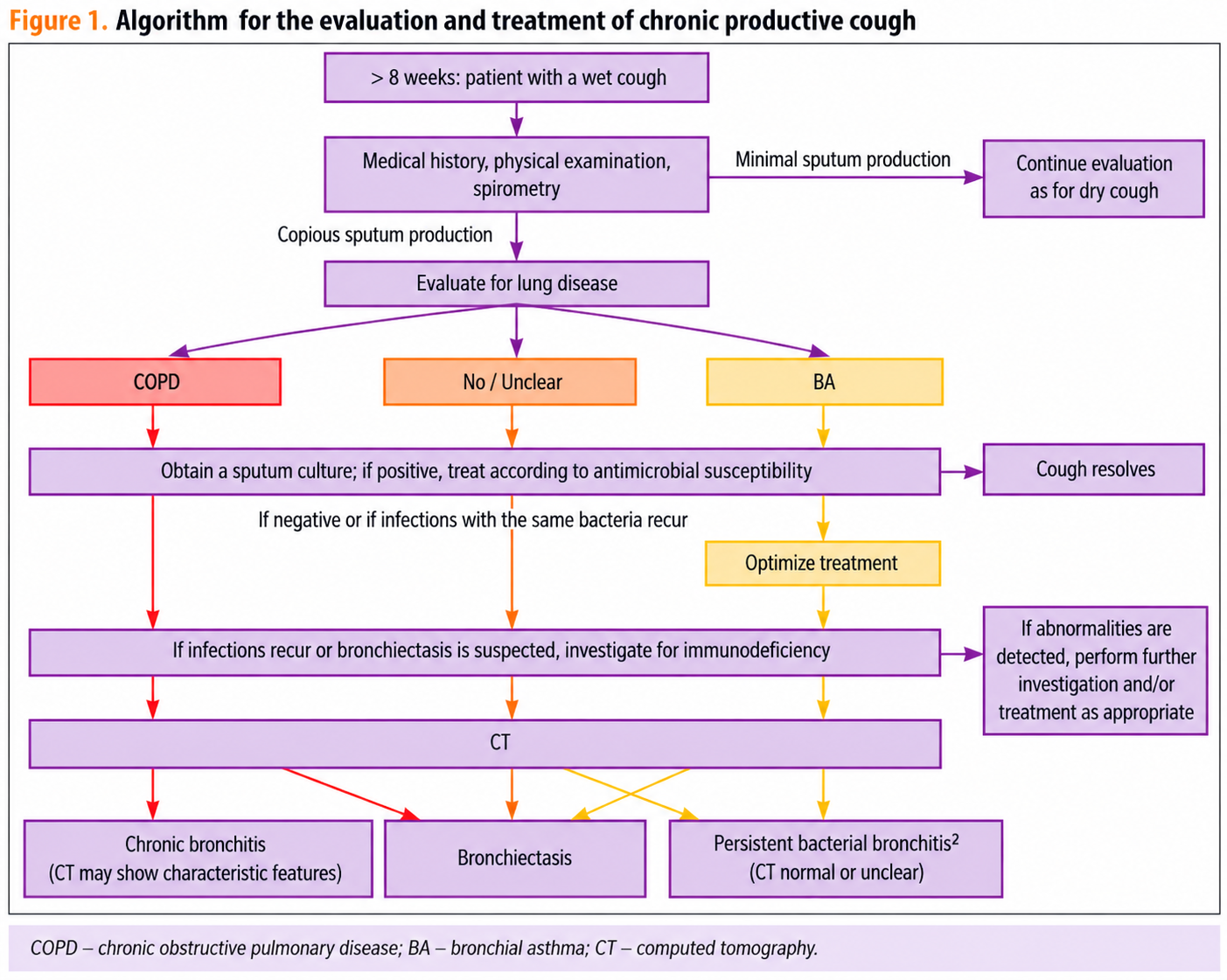
Although all of the previously discussed causes of persistent cough may cause both dry and wet cough, some authors suggest that certain causes are more characteristic of wet cough. In decreasing order, these are bronchiectasis, chronic bronchitis, asthma, eosinophilic bronchitis, and immunodeficiency states. Taking these causes into account, a separate algorithm for the evaluation and treatment of chronic wet cough has been proposed.
Non-Specific Treatment
Non-specific treatment should be reserved for patients whose cough persists despite following the strategies outlined in the algorithms and for whom specific treatment is ineffective. It is believed that these patients have increased sensitivity of the cough reflex.
While cough receptor antagonists are being developed and tested, non-specific therapy includes narcotic and non-narcotic medications, as well as centrally and peripherally acting cough suppressants. Some authors argue that these medications are ineffective and that the observed benefit is attributable only to the placebo effect.
There are also non-pharmacological approaches to the treatment of persistent cough. These include speech therapy, breathing exercises, and cough suppression techniques. A systematic review of studies evaluating these methods showed significant improvements in patients' quality of life, reduced cough severity, and decreased cough frequency. However, the study design has been criticized, so the conclusions should be interpreted with caution.
Summary
Persistent cough is a very distressing symptom that often leads patients to seek medical attention. Upper airway cough syndrome, asthma, and GERD account for more than 90% of cases of persistent cough. Cough may be the only symptom of these diseases. Further evaluation of patients with persistent cough is necessary only after these causes have been ruled out.
Because of the relatively straightforward diagnostic and treatment strategy, early consideration of non-asthmatic eosinophilic bronchitis is recommended in patients who complain of severe persistent wet cough. Bronchiectasis and chronic bronchitis should also not be overlooked.
The proposed algorithms may facilitate the evaluation and treatment of persistent cough in clinical practice. Non-specific treatment should only be considered in patients for whom appropriate specific therapy has been ineffective.
References
- R. S. Irwin, et al. Managing cough as a defense mechanism and as a symptom. A consensus panel report of the American College of Chest Physicians. Chest, vol. 114, no. 2 Suppl Managing, pp. 133S-181S, Aug. 1998.
- R. S. Irwin, et al. Diagnosis and management of cough executive summary: ACCP evidence-based clinical practice guidelines.Chest, vol. 129, no. 1 Suppl, pp. 1S-23S, Jan. 2006.
- N.-H. Kwon, M.-J. Oh, T.-H. Min, B.-J. Lee, and D.-C. Choi. Causes and clinical features of subacute cough. Chest, vol. 129, no. 5, pp. 1142–1147, May 2006.
- M. R. Pratter. Overview of common causes of chronic cough: ACCP evidence-based clinical practice guidelines. Chest, vol. 129, no. 1 Suppl, pp. 59S-62S, Jan. 2006.
- C. Michaudet and J. Malaty, “Chronic Cough: Evaluation and Management,” Am Fam Physician, vol. 96, no. 9, pp. 575–580, Nov. 2017.
- W.-J. Song, et al. The global epidemiology of chronic cough in adults: a systematic review and meta-analysis. Eur. Respir. J., vol. 45, no. 5, pp. 1479–1481, May 2015.
-
- A. Kelsall, S. Decalmer, K. McGuinness, A. Woodcock, and J. A. Smith. Sex differences and predictors of objective cough frequency in chronic cough. Thorax, vol. 64, no. 5, pp. 393–398, May 2009.
- J. A. Kastelik, I. Aziz, J. C. Ojoo, R. H. Thompson, A. E. Redington, and A. H. Morice. Investigation and management of chronic cough using a probability-based algorithm. Eur. Respir. J., vol. 25, no. 2, pp. 235–243, Feb. 2005.
- R. S. Irwin, F. J. Curley, and C. L. French. Chronic cough. The spectrum and frequency of causes, key components of the diagnostic evaluation, and outcome of specific therapy. Am. Rev. Respir. Dis., vol. 141, no. 3, pp. 640–647, Mar. 1990.
- S. S. Birring. Controversies in the evaluation and management of chronic cough. Am. J. Respir. Crit. Care Med., vol. 183, no. 6, pp. 708–715, Mar. 2011.
- D. S. Tseng, J. Kwong, F. Rezvani, and A. O. Coates. Angiotensin-converting enzyme-related cough among Chinese-Americans. Am. J. Med., vol. 123, no. 2, pp. 183.e11–15, Feb. 2010.
- Algorithm for cough evaluation - UpToDate [Online]. Available: https://www-uptodate-com.ezproxy.dbazes.lsmuni.lt/contents/image?imageKey=PULM%2F67147&topicKey=PULM%2F1460&search=chronic%20cough&rank=1~150&source=see_link. [Accessed: 18-Mar-2019].
- P. J. Kahrilas, et al. American Gastroenterological Association Medical Position Statement on the management of gastroesophageal reflux disease. Gastroenterology, vol. 135, no. 4, pp. 1383–1391, 1391.e1–5, Oct. 2008.
- M. J. Martin and T. W. Harrison. Causes of chronic productive cough: An approach to management. Respir Med, vol. 109, no. 9, pp. 1105–1113, Sep. 2015.
- D. C. Bolser. Pharmacologic management of cough. Otolaryngol. Clin. North Am., vol. 43, no. 1, pp. 147–155, xi, Feb. 2010.
- K. F. Chung. Chronic cough: future directions in chronic cough: mechanisms and antitussives. Chron Respir Dis, vol. 4, no. 3, pp. 159–165, 2007.
- S. Chamberlain, S. S. Birring, and R. Garrod. Nonpharmacological interventions for refractory chronic cough patients: systematic review. Lung, vol. 192, no. 1, pp. 75–85, Feb. 2014
Journal "Internistas" No.5-6, 2019
