
Sympathetic denervation of renal arteries: doubts and perspectives
Arterial hypertension (AH) is one of the most common chronic cardiovascular diseases (CVD). Effective and adequate control of hypertension remains an important clinical issue. AH is one of the major risk factors for serious and potentially fatal CVD complications, such as myocardial infarction and stroke, as well as various forms of heart, eye, and kidney damage.
In 2000, approximately 1 billion people worldwide were registered as having hypertension, and it was estimated that by 2025 this number would reach 1.56 billion [1]. It is also known that 14 to 30 percent of patients have resistant hypertension (RH), which does not respond adequately to treatment with multiple antihypertensive drugs [2], and this resistance is increasing. According to recommendations for the diagnosis and treatment of arterial hypertension, RH is diagnosed when:
- more than 3 antihypertensive drugs (one of them a diuretic) are ineffective, and systolic blood pressure (SBP) remains ≥160 mm Hg, and in patients with type 2 diabetes ≥150 mm Hg; during 24-hour BP monitoring, the average BP is >135/85 mm Hg during the day and >120/70 mm Hg at night;
- no BP-increasing drugs are taken;
- lifestyle is adequately adjusted (no smoking, controlled body weight, and physical activity).
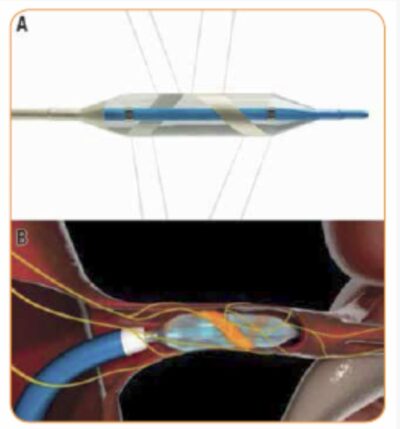 Fig. A, B. OneShot sympathetic renal denervation system
A significant number of antihypertensive drugs themselves have side effects that limit their use, which in turn encourages the search for new methods and approaches for the effective treatment or control of AH.
Recently, renal sympathetic denervation (PIAD) has increasingly been mentioned as one of the innovative methods for treating resistant arterial hypertension (RAH). This is a minimally invasive procedure in which a special electrode is inserted into the main renal artery, and the connection between the nervous system and the renal arteries is disrupted using radiofrequency or ultrasound energy, thereby affecting mechanisms that maintain elevated blood pressure.
Clinical Trials
In many literature sources, PIAD is described as a promising, safe, and effective method, opening new possibilities in the treatment of both common and resistant hypertension [3–6]. For this purpose, new methodologies and tools for renal denervation are being developed and improved.
One of them is the so-called OneShot system for renal denervation (OneShot system; Covidien, Mansfield, MA, USA), which uses a catheter for cryoablation, performing a single 2-minute circular ablation in each renal artery. The procedure was initially tested in an experimental dog model [8] and later, after optimization and improvement, was performed in humans [9]. In one of the first multicenter Symplicity HTN-1 trials, renal artery sympathetic denervation was performed in 45 patients with RAH (mean blood pressure 177/101 mm Hg, taking an average of 4.7 antihypertensive medications) [14].
The main evaluation criteria were perioperative and long-term treatment safety, as well as the antihypertensive effect. After 4 weeks, lower systolic blood pressure (SBP) and diastolic blood pressure (DBP) were observed, with reductions of 14 and 10 mm Hg, respectively. After 12 months, decreases of 27 and 17 mm Hg in blood pressure were recorded. Data after 36 months showed a long-term reduction in SBP and DBP of 31 and 16 mm Hg, respectively. After 3 weeks, decreased norepinephrine levels in blood plasma were found in 47% of patients, indicating reduced activity of the renal sympathetic nervous system [14]. The Symplicity HTN-2 trial involved 106 patients with RAH [15].
The treatment group consisted of patients who underwent renal artery sympathetic denervation and continued medical treatment. The control group consisted of patients who did not undergo denervation but continued treatment with antihypertensive drugs. The average blood pressure of patients before treatment was 178/96 mm Hg, with patients taking an average of 5.3 antihypertensive medications.
After 6 months, blood pressure in the treatment group decreased by an average of 32/12 mm Hg (p <0.0001), while there were no changes in the control group. Ambulatory blood pressure monitoring for 24 hours showed a significant decrease in blood pressure by an average of 11/7 mm Hg in the treatment group and no changes in the control group (p = 0.007; n = 20). A response to treatment after 6 months, defined as a reduction in SBP >10 mm Hg, was observed in 84% of patients.
In the larger Symplicity HTN-3 trial, 535 patients with RAH participated. After 6 months, blood pressure was lower in the PIAD group by 14.13 ± 23.93 mm Hg, compared with 11.74 ± 25.94 mm Hg in the control group. Ambulatory 24-hour blood pressure monitoring showed a decrease in SBP of 4.79 ± 17.25 mm Hg in the PIAD group, while in the control group it was 1.96 mm Hg. No significant difference between the groups was found [17]. It is important to consider that the effectiveness of the procedure is evaluated after 6 months.
It is also believed that other factors could have influenced the study results: the experience of the center and the physician performing the procedure, the type of system used, and suboptimal baseline treatment. Another interesting observation was that this procedure was significantly less effective in Africans and African Americans compared with patients of European descent, which was associated with potentially different pathophysiology of arterial hypertension [18].
Although the Symplicity HTN-3 trial did not demonstrate the effectiveness of percutaneous renal denervation (PIAD) in treating resistant arterial hypertension (RAH), many other clinical trials are currently underway to demonstrate the effectiveness of this procedure. One of them is the RAPID prospective multicenter trial. It involved 11 European clinical centers, including New Zealand. The trial utilized the OneShot PIAD system. The study included 50 patients with RAH [18]. The average age of the participants was 63 ± 9.5 years, with 58% being male and 42% female. On average, patients were taking 5.1 ± 1.7 antihypertensive drugs.
After the PIAD procedure, patients were monitored for up to 12 months. After 6 months of follow-up, mean systolic blood pressure (SBP) decreased by 10.6 mm Hg and diastolic blood pressure (DBP) by 6.4 mm Hg. After 12 months of follow-up, SBP decreased by 9.1 mm Hg and DBP by 4.5 mm Hg from baseline. No significant nocturnal blood pressure changes were observed. No significant complications related to the PIAD procedure were identified in patients participating in the 12-month follow-up. Renal artery stenosis was detected in one patient.
Summary
The results of several multicenter trials have shown that PIAD is a safe and effective therapeutic procedure [13–16]. Proper patient selection, as well as the experience of the center and the physician performing the procedure, are crucial to ensuring the effectiveness of the procedure.
