
First Unprovoked Seizure in Adults: Prognosis and Treatment Recommendations
Introduction
Approximately 150,000 adults in the United States experience a first unprovoked seizure each year. Even if seizures do not recur, the event itself can have physical and psychological consequences because it is associated with social restrictions, including driving restrictions and limitations in professional activities. Therefore, guidelines that help evaluate a first unprovoked seizure and determine whether long-term treatment with antiepileptic drugs (AEDs) may be appropriate are particularly important.
All unprovoked seizures can be divided into two broad categories: those of unknown etiology and those associated with a pre-existing central nervous system (CNS) lesion, such as cerebral palsy, previous head trauma or another neurological disorder, or with a progressive CNS disease. Seizures caused by metabolic disturbances, alcohol intoxication, concomitant infection, current head trauma or stroke—so-called symptomatic seizures—are not reviewed or discussed in this article. After a first unprovoked seizure, the clinician's main concerns are usually to assess the risk of seizure recurrence and determine whether AED treatment could reduce the risk of recurrence during the first year or later, and whether the benefits of AED therapy would outweigh the potential harm caused by adverse reactions.
A review by the American Academy of Neurology and the American Epilepsy Society evaluated 2,613 article abstracts from MEDLINE, Embase and Cochrane databases, of which 47 articles were selected for the final analysis. The recommendations presented in these articles met Level I or II evidence criteria, meaning that the published data were obtained from randomized controlled clinical trials conducted in appropriately selected patient populations.
Risk of Recurrent Seizures
One of the first questions of interest to clinicians is the risk of seizure recurrence after a first seizure and whether this risk depends on the type of seizure experienced. Most of the studies reviewed included patients who had experienced generalized tonic-clonic seizures, while only a small proportion had experienced complex partial seizures. Unfortunately, these studies generally did not take into account whether AED treatment had been prescribed after the first seizure, meaning that the study populations were not homogeneous in this respect.
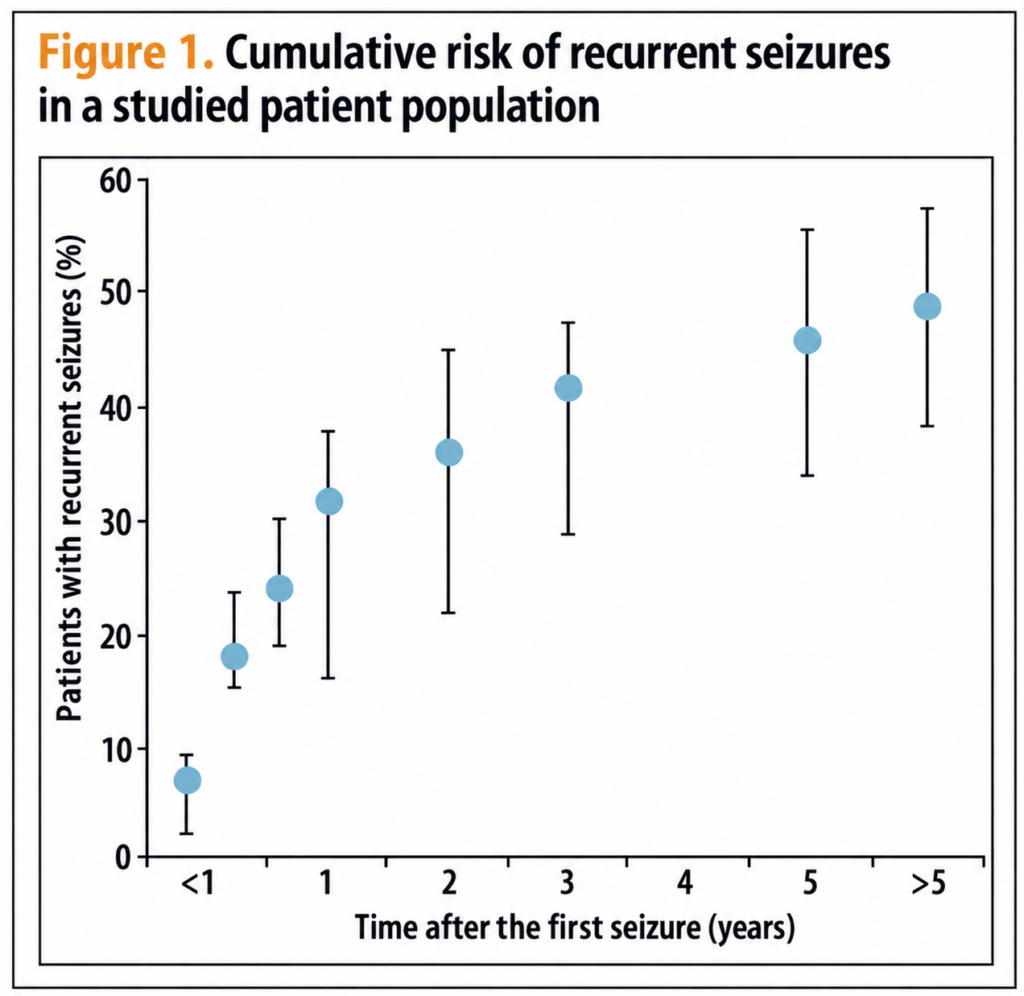
According to the authors, the cumulative risk of seizure recurrence increases over time, although most recurrent seizures occur within the first 1–2 years. Overall, 32% of the patients studied experienced a second seizure within 1 year, while 46% experienced a second seizure within 5 years after the first episode (Figure 1).
The risk of recurrence varied considerably between studies because, as noted above, some patients received AEDs whereas others did not. The studies attempted to identify factors associated with a higher risk of seizure recurrence. A previous brain injury, including stroke, cerebral palsy, previous trauma, neuroinfection or developmental delay, epileptiform activity recorded on electroencephalography (EEG), abnormal neuroimaging findings and nocturnal seizures were associated with a several-fold greater risk of experiencing a second seizure compared with patients without these factors in their medical history.
For example, patients with previous CNS injury had twice the risk of experiencing a second seizure compared with individuals without such a history: 26%, 41% and 48% at 1, 3 and 5 years, respectively, compared with 10%, 24% and 29% among patients whose first seizure was of unknown etiology.
Similarly, the risk was increased in patients with epileptiform activity on EEG, abnormal neuroimaging findings on computed tomography (CT) or magnetic resonance imaging (MRI), or nocturnal seizures compared with patients whose first seizure occurred during the daytime. A review of the clinical trial results showed that:
- Patients with a history of structural CNS injury had a 2.55-fold greater risk of experiencing another seizure within 5 years than patients with a first seizure of unknown etiology (95% confidence interval [CI], 1.44–4.51).
- Patients with an abnormal EEG had a 2.16-fold greater risk of experiencing a second seizure within 5 years than those with a normal EEG (95% CI, 1.07–4.38).
- Patients with abnormal brain imaging findings had a 2.44-fold greater risk of experiencing a second seizure within 4 years than those with normal brain CT or MRI findings (95% CI, 1.09–5.44).
- Nocturnal seizures were associated with a 2.1-fold greater risk of a second seizure within 4 years than daytime seizures (95% CI, 1.0–4.3).
Factors that did not increase the risk of a second seizure included patient age, sex, family history of epilepsy, seizure type, status epilepticus or a series of seizures during the first episode.
In summary, the risk of recurrent unprovoked seizures is greatest during the first 2 years, ranging from 21% to 45% according to different authors (Level A evidence). The risk increases in patients with an unfavorable neurological history (Level A evidence), abnormalities on EEG (Level A evidence) or brain imaging (Level B evidence), or when the first seizure occurs at night (Level B evidence).
Risk of Recurrent Seizures and AED Treatment
Two important questions arise: whether AED treatment reduces the risk of recurrent seizures during the first 2 years and whether early AED treatment increases the likelihood of long-term remission.
According to the studies reviewed, AED treatment reduced the risk of recurrent seizures during the first 2 years. Although the risk of seizure recurrence is cumulative—that is, a considerably larger proportion of patients will experience a second seizure over 5 years than during the first year alone—the second seizure most commonly occurs within the first 2 years after the initial event.
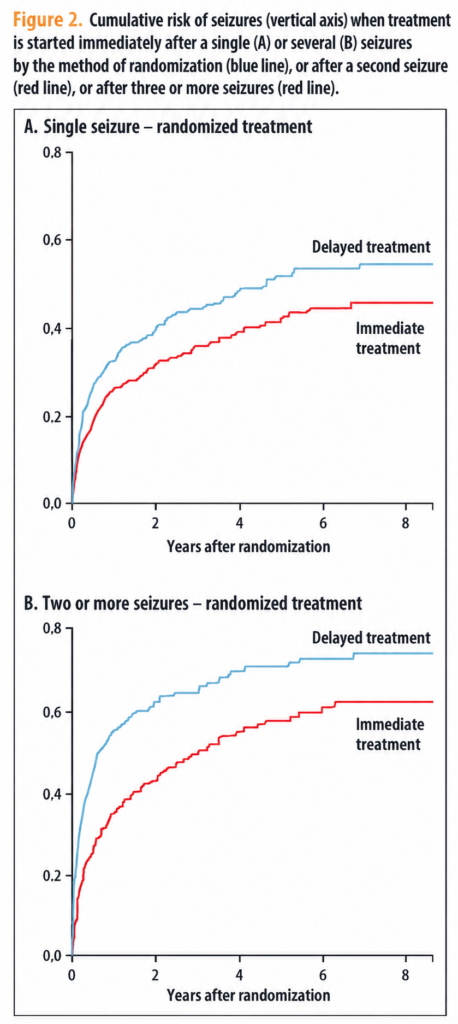
It was found that initiating AED treatment within 1 week after the first seizure reduced the risk of recurrent seizures during the first year by 35% compared with a group in which treatment was initiated later, 1–3 months after the first seizure (Level B evidence). However, although seizure control appeared to be better in the first group, assessment of both groups using a quality-of-life questionnaire revealed no significant differences after 2 years (Level C evidence).
Another important question is whether immediate AED treatment after a first seizure increases the likelihood of long-term remission lasting more than 3 years compared with patients in whom treatment is initiated only after a second seizure. According to the authors, no significant differences were found between these two groups (Level B evidence). Therefore, the treatment strategy may be individualized according to clinical practice and patient priorities (Figure 2).
Adverse Effects of Antiepileptic Drugs
According to the studies reviewed by the authors, adverse reactions occurred in 7–31% of patients receiving AED treatment. No life-threatening adverse reactions or deaths were reported, although the study populations were not large. Most adverse reactions were mild to moderate and resolved after the patient was switched to another AED (Level B evidence).
The medications most commonly used in the studies were carbamazepine, valproic acid, lamotrigine, phenobarbital and phenytoin. Some of these drugs are now less relevant to clinical practice and have been replaced by newer agents. The spectrum of adverse reactions varied, but most resolved after discontinuation of the drug or reduction of its dose.
Clinical trials of newer AEDs have reported adverse reaction rates ranging from 7% to 13%. Adverse reactions are also considered considerably less frequent at the beginning of AED treatment because monotherapy and the lowest effective AED dose are generally used.
Summary and Discussion
Patients who have experienced a first unprovoked seizure should be informed that the risk of seizure recurrence is greatest during the first 2 years after the initial seizure, affecting 21–45% of patients (Level A evidence). Patients at higher risk include those with an unfavorable neurological history (Level A evidence), abnormalities on EEG (Level A recommendation) or brain imaging (Level B evidence), or those who experienced a nocturnal seizure (Level B evidence).
Immediate AED treatment reduces the risk of recurrent seizures during the first 2 years by 35% (Level B evidence), but early initiation of AED therapy does not affect long-term remission (Level B evidence). Adverse reactions to AEDs occur in 7–31% of patients. They are generally mild or moderate and resolve after dose reduction or switching to another AED (Level B evidence).
The question therefore arises as to whether AED treatment is appropriate after a first unprovoked seizure. In clinical practice, AEDs are most commonly prescribed after a second seizure because the risk of further seizures is then high: 57% of patients experience another seizure during the first year and 73% within 4 years.
After a first seizure, the decision to prescribe an AED should be individualized by assessing each patient's risk factors, including previous CNS injury, a nocturnal seizure, and abnormalities on EEG or neuroimaging, and by discussing the potential benefits and harms of AED treatment with the patient. Immediate treatment may be particularly important when social restrictions are a concern, including driving and occupational limitations, because seizure recurrence may result in prolonged restrictions regardless of subsequently initiated AED treatment.
As demonstrated by the studies reviewed, immediate AED treatment does not affect long-term seizure remission. According to one study, AED treatment did not reduce the risk of sudden unexpected death in epilepsy.
Prepared by Dr. Giedrė Krištopaitytė
Republican Panevėžys Hospital
Source: Internistas, No. 6
