
The Importance of Manufacturing Technology for the Absorption and Effectiveness of Vitamins and Minerals
The term “vitamin” was first used in 1912 by the Polish biochemist Kazimierz Funk. Vitamins (Latin vita – life, aminum – amine) are low-molecular-weight, biologically active organic compounds essential for normal metabolism and vital functions. They perform coenzyme, antioxidant, and hormonal functions and regulate the body’s energy processes. The body generally does not produce vitamin molecules at all or produces them in insufficient amounts; therefore, they must be obtained from food or in the form of specialized vitamin preparations. Humans require a variety of vitamins, both water-soluble and fat-soluble. They are essential because many vital reactions could not take place without them.
A Modern Problem – Hypovitaminosis
For modern people, particularly those living in industrialized countries, obtaining sufficient amounts of nutritionally complete foods can be difficult because such foods are expensive or rarely available in mass-market retail. A large randomized study conducted in the United States revealed striking findings. It found that people obtain from food:
- 25–50% less vitamin A than the reference nutritional value (NRV);
- 25% less vitamin C than the NRV;
- 80–90% less vitamin E than the NRV;
- 25% less folic acid than the NRV;
- 50% less calcium than the NRV, etc.
Of course, the most important source of nutrients is our daily food. However, can we be certain today that we obtain all essential nutrients from food? Refined, technologically processed food, although tasty and aesthetically appealing, is often nutritionally incomplete and lacks nutrients necessary for healthy development and the maintenance of physiological functions. Changes in food composition and reductions in nutrient content mean that many people develop vitamin deficiencies, or hypovitaminosis. Patients with hypovitaminosis begin to experience weakness and reduced appetite, become nervous, and have reduced resistance to disease. The amount of vitamins required by the body depends on the pace of modern life, dietary patterns, climatic conditions, and other internal and external factors (Table 1).
Table 1. Causes of Vitamin Deficiency
| Factor | Description |
|---|---|
| Food composition | Food must contain a certain amount of proteins, fats, carbohydrates, minerals, and vitamins. Imbalances in these components alter the body’s need for vitamins and minerals. |
| Constant nervous tension | Stress, chronic fatigue. |
| Environmental temperature | Many vitamins are required in greater amounts when the ambient temperature is higher or lower than usual. At high ambient temperatures, the need for vitamins increases by 30–50%, especially for vitamins A, B1, B2, and C, when the body is exposed simultaneously to high temperatures and ultraviolet radiation. |
| Physical activity | The need for vitamins (especially B1, B2, B6, PP, and C) and minerals (potassium, magnesium) is directly proportional to physical activity. |
| Infections/viral diseases | In patients with these conditions, the need for many vitamins and minerals increases. |
| Changes in the physiological state of the female body | A woman’s natural cycle, pregnancy, and breastfeeding increase the body’s need for vitamins and minerals. |
| Age | The need for vitamins and minerals is higher in children and older adults because their intestinal absorption is reduced. |
| Chronic diseases | More vitamins and minerals are required by patients with chronic diseases, as well as for their prevention. |
Choosing the Right Vitamins Depends on Manufacturing Technology
When discussing vitamin and mineral supplements, several essential points should be kept in mind:
- Vitamins and minerals are necessary, valuable, and beneficial only when the body is deficient in them (Table 1).
- If the body has sufficient amounts of vitamins and minerals, additional supplementation provides no benefit and may even be harmful. However, cases of hypervitaminosis are almost never encountered in real life and, consequently, in clinical practice.
- Excessive consumption of vitamins and minerals can be harmful to health; therefore, dietary supplements with compositions close to the recommended daily intake are recommended.
- Once it has been established that vitamin and mineral supplementation is necessary, according to the latest research data, the most important consideration is to choose a product that ensures physiological effects, efficacy, and maximum absorption.
Pharmacies offer a wide range of dietary supplements containing vitamins and micro- or macroelements, but their nutritional and physiological value is not the same. According to the latest research data, dietary supplements manufactured using conventional technologies, in which micro- and macroelements are mixed together in a single combination preparation, are not physiologically rational because their components are released from the tablet simultaneously in the stomach. In the gastric environment, they may interact unfavorably, form insoluble or poorly absorbed compounds, or even inhibit one another’s activity.
For example, when iron and magnesium are “mixed” using conventional manufacturing technology, they inhibit each other during absorption and may even act antagonistically. Because of incomplete absorption or the formation of insoluble compounds, such preparations may irritate the gastrointestinal mucosa and cause dyspepsia and abdominal discomfort.
Various manufacturing methods and technologies have been proposed to increase the effectiveness of vitamin and mineral preparations and improve their absorption and physiological activity. Studies indicate that enteric coating (EC) technology comes closest to ensuring physiological action and effectiveness. Vitamins and minerals processed using EC technology are resistant to the acidic environment of the stomach, and as much as 60–80% of their components are released in the intestinal environment.
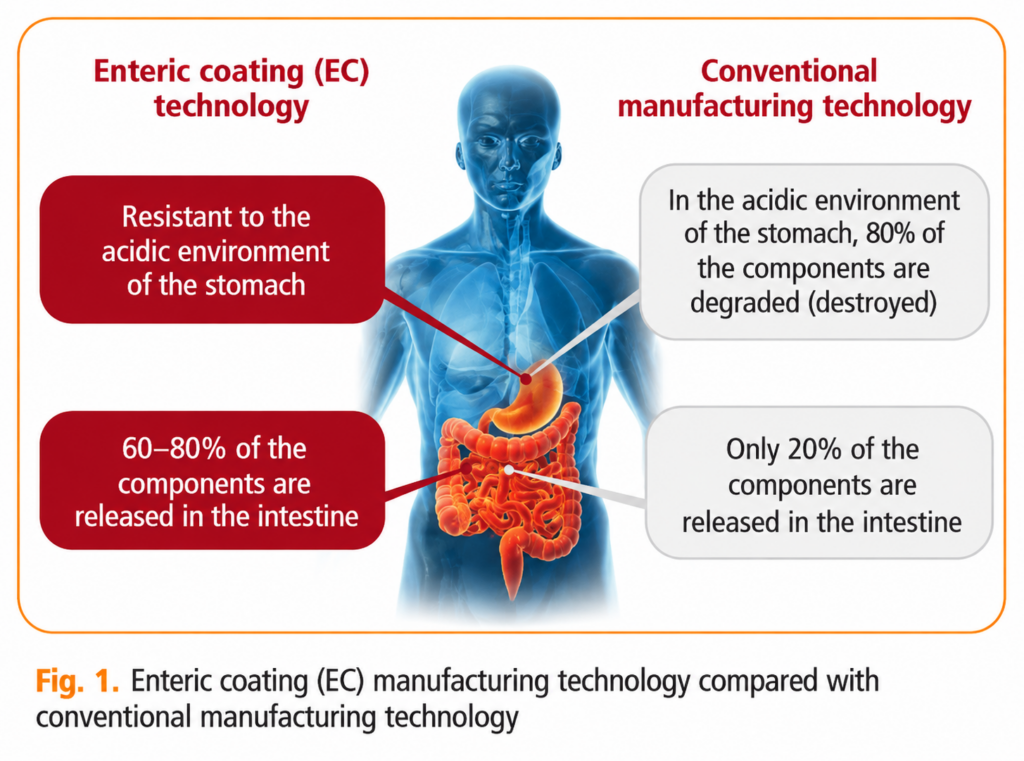
By contrast, vitamins and minerals not manufactured using EC technology are degraded by gastric acids, reducing their effectiveness. In such cases, only about 20% of the components remain intact and reach the intestinal environment.
Prepared by R. Jasiukevičiūtė
Source: “Lietuvos gydytojo žurnalas”
